

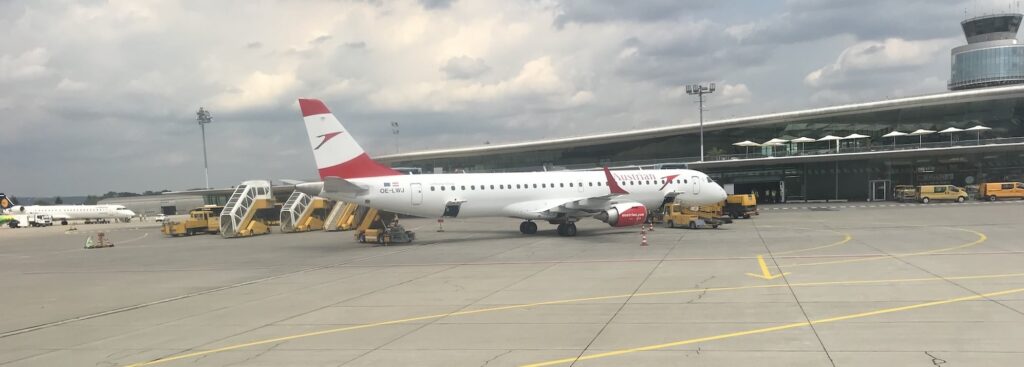
If you’re planning a visit to Vienna, there’s a good chance you’ll be flying to Vienna. For many international travellers—especially those coming from the UK, Ireland, Scandinavia or outside Europe—flying is the fastest and most practical way to reach Austria’s elegant capital. Vienna International Airport is well-connected to major cities around the world and offers a smooth, straightforward arrival experience.
Still, whether flying is the best option for you depends on where your journey begins. If you’re coming from London, Dublin or Stockholm, direct flights are frequent and often quite affordable. From London alone, up to five airlines fly nonstop from three airports; our guide to London to Vienna flights compares them. Travellers from North America can fly nonstop with Austrian Airlines from cities like New York, Washington, Chicago and Boston (see our Austrian Airlines guide), while travellers from Asia often connect via Dubai or Doha, or via European hubs such as Frankfurt, Amsterdam or Zurich.
On the other hand, if you’re travelling from Central Europe—say, Munich, Prague or Budapest—you might want to consider taking the train instead. Rail connections to Vienna are fast, frequent and often just as quick as flying when you count in airport travel time.
Not sure yet what works best for your trip? Our main overview, How to get to Vienna, helps you compare all the options.
Vienna International Airport (VIE)

Vienna’s main airport lies about 18 kilometres southeast of the city centre and is Austria’s largest and busiest aviation hub. It’s a modern, well-organised airport that handles over 170 destinations worldwide, with everything from budget flights to full-service international carriers.
You’ll find the terminals easy to navigate, signage is clear and in both German and English, and there’s free Wi-Fi throughout the building. Whether you’re flying in on a short European hop or arriving after a long-haul journey, the airport is generally efficient and traveller-friendly.
Austrian Airlines, the country’s national carrier, offers extensive connections across Europe and beyond. Budget airlines like Ryanair and easyJet are a popular choice for short-haul flights, while larger carriers including Lufthansa, KLM and Swiss handle most of the connecting traffic. If you’re flying in from further afield, airlines such as Emirates, Qatar Airways and Turkish Airlines provide good links from the Middle East and Asia.
Understanding the terminals at Vienna Airport
One of the great things about Vienna International Airport is how easy it is to find your way around. Unlike many larger airports with separate terminal buildings, Vienna Airport is essentially one connected building, with different areas for check-in and for departures.
There are three check-in areas: Terminal 1, Terminal 1A and Terminal 3. Terminal 1A is a smaller building opposite Terminal 1, used for check-in and bag drop only. You may still see Terminal 2 on older maps, but it’s no longer used for check-in. After security, everything is connected and within walking distance—no shuttle buses or terminal transfers required.
The gate letter tells you where you’re going after security. Gates B, C and F are for flights within the Schengen area. Gates D and G are for non-Schengen destinations, including the UK, Ireland and all long-haul flights. To get to the D and G gates you pass through passport control, which both gate areas share.
Which airline uses which area?
While things can change depending on the time and destination, here’s a general idea of where to go:
| Airline(s) | Check-in area | Schengen gates | Non-Schengen gates |
| Austrian Airlines, Lufthansa, SWISS, Brussels Airlines | Terminal 3 | F | G (sometimes D) |
| British Airways, KLM, Air France, Turkish Airlines, Iberia, Finnair | Terminal 1 | B / C | D |
| Ryanair | Terminal 1 | B / C | D |
| easyJet, Jet2, Vueling, Transavia, Pegasus, SunExpress | Usually Terminal 1A | B / C | D |
Flying with an airline that isn’t listed? Check your booking or the departure screens for your check-in area. You can check in at the counters or use the self-service kiosks, and security screening is quick and efficient in most cases. Once you are through security, you’ll find plenty of cafés, shops, and quiet seating areas while you wait for your flight.
Check-in areas and gates can change depending on your airline, time of day, and final destination. Always check your boarding pass, airline app, or the airport screens for the most accurate, up-to-date information.
While we aim to keep this guide helpful and current, we are not responsible for last-minute changes made by airlines or the airport. On the website of Vienna Airport you can check the actual arrival- and departure time of your flight.
Airport lounges at Vienna: worth a visit?
If you’re flying business class or hold status with an airline alliance like Star Alliance or SkyTeam, you’ll have access to one of several lounges at Vienna International Airport. The Austrian Airlines Business and Senator Lounges, located near Gates F and G, are the most commonly used, offering comfortable seating, quiet workspaces, hot and cold food, and a good selection of drinks. Austrian also has a Business Lounge at the D gates. For everyone else, there are two airport-run lounges, the VIENNA Lounge in Terminal 1 and the SKY Lounge in Terminal 3, which you can use with Priority Pass or by paying at the entrance.
Finding the lounges is easy—just follow the signs after security. Most are located airside, within a few minutes’ walk from the departure gates. If you have a long layover or want to unwind before your flight, they’re a solid option—especially the newer Austrian lounges, which are well-rated by frequent flyers. Flying outside Schengen? Visit any Schengen-side lounge before passport control, as you can’t go back afterwards.
Getting from Vienna Airport to the city centre

Reaching the centre of Vienna from the airport is quick and easy, with several reliable transport options depending on your budget, schedule, and preference for comfort. Vienna International Airport is located about 18 kilometres southeast of the city and is well-connected by both public and private transport.
By train
The fastest and most efficient way into the city is the City Airport Train (CAT), a non-stop service that takes you to Wien Mitte in just 16 minutes. Trains run every 30 minutes, and you can buy tickets online, at airport kiosks or directly in the CAT app.
A cheaper alternative is the S-Bahn (line S7), which also connects the airport with central Vienna, stopping at several stations along the way, including Wien Mitte and Praterstern. The journey takes about 25 minutes and is included in the standard Vienna public transport ticket system.
By bus
Numerous airport buses connect Vienna Airport with key locations in the city, including Schwedenplatz, Westbahnhof and Donaustadt. Travel times vary between 20 and 40 minutes, depending on traffic. Buses are clean, punctual, and especially convenient if you’re staying in a part of the city not directly served by the train lines.
By taxi or ride-hailing
A taxi from the airport to the city centre takes around 20–30 minutes and costs approximately €35 to €45, depending on traffic and time of day. Services like Uber and Bolt also operate in Vienna, offering fixed fares that can be slightly cheaper than traditional taxis.
Just landed in Vienna?
Find out how to get from Vienna International Airport to the city centre — fast, cheap, or comfortably. Read our full airport transfer guide →
Flying to Vienna: when to book and what to expect
Just like with most European destinations, flight prices to Vienna can vary widely depending on when you book and when you travel. In general, the cheapest months to fly are January, February and November, when tourism is quieter and fewer events are scheduled. Prices tend to rise during the summer holidays, Easter, and the December festive season, especially around Vienna’s famous Christmas markets.
To get the best deal:
- Try to book 6–8 weeks in advance for short-haul flights within Europe
- Use flexible date search tools to compare prices over several days
- Consider flying midweek—Tuesdays and Wednesdays are often cheaper than weekends
Long-haul flights from North America or Asia are more stable in price, but still fluctuate around holiday seasons. Booking 2–4 months ahead is usually sufficient, unless you’re travelling during peak summer.
Luggage and check-in at Vienna Airport
Vienna Airport is well-organised and typically efficient when it comes to check in and security. Austrian Airlines and other major carriers offer self-service kiosks, and online check-in is available for almost all airlines. If you’re flying with hand luggage only and have your boarding pass on your phone, you can typically head straight to security.
Flying Austrian, Lufthansa or SWISS? Since autumn 2026, the Lufthansa Group airlines only let you check in online if you’re logged in with a free Travel ID account. Without one, you can still check in at the airport. Our Austrian Airlines guide explains who needs one and how it works.
Security screening is typically fast, but during peak times (early mornings, late afternoons, and pre-holiday weekends), lines can get longer—especially in the Schengen departure areas. Flying to the UK or outside Europe? Allow extra time for passport control before the D and G gates. Arriving 2 hours before a short-haul flight and 3 hours before a long-haul flight is still a good rule of thumb.
Most shops and restaurants are located airside, so once you’re through security, you’ll have options to relax, grab a bite, or browse duty-free. Just keep in mind that prices at the airport can be noticeably higher than in the city—especially for food, drinks, and basic travel items.
Alternatives to Vienna Airport
While Vienna International Airport (VIE) is by far the most convenient and best connected airport for reaching the Austrian capital, there are a few alternative airports that might be worth considering—especially if you’re flying with low-cost carriers or searching for flexible options.
Bratislava Airport (BTS) – the low-cost alternative
Located just 60 kilometres east of Vienna, Bratislava Airport in Slovakia is surprisingly close—often closer in travel time than some secondary airports in other major European cities. Budget airlines such as Ryanair and Wizz Air use Bratislava as a hub for flights from the UK, Ireland, and parts of Southern Europe.
Getting to Vienna from Bratislava is straightforward. You can take:
- A direct FlixBus or Slovak Lines coach, which takes about 1 hour to Vienna city centre.
- A train from Bratislava hlavná stanica to Vienna Hauptbahnhof, also about 1 hour, though you’ll first need to get from the airport to the train station by taxi or local bus.
For budget travellers, this route can be significantly cheaper—but less convenient, especially if you’re arriving late at night or with a lot of luggage.
Linz and Graz airports – regional options
Both Linz Airport and Graz Airport are small regional airports within Austria that occasionally offer flights from cities like Frankfurt, Düsseldorf, or Zurich. They are clean, efficient, and easy to navigate, but only make sense if you’re already planning to visit those regions.
From Linz, you can reach Vienna in around 1.5 hours by train. From Graz, it’s closer to 2.5 hours. Flights to these airports are often more expensive or limited in frequency, so for most travellers, they’re not a practical alternative to flying directly into Vienna.
Most frequently asked questions
We’ve collected the most frequently asked questions from our readers—based on messages we receive through email and social media. If you’re planning to fly into Vienna for the first time, chances are you’ll find your answer here too.
Is Vienna Airport easy to navigate?
Yes, Vienna International Airport is compact, well signposted and very manageable—even for first-time visitors. All check-in areas and gates are located within one connected building, and walking distances are short. Most signage is in both German and English.
Which check-in area do I need at Vienna Airport?
Austrian Airlines and the other Lufthansa Group airlines check in at Terminal 3. British Airways, KLM, Air France and Ryanair use Terminal 1, and easyJet and Jet2 usually check in at Terminal 1A. Always confirm in your booking, as assignments can change.
What is the fastest way to get from the airport to the city?
The fastest option is the City Airport Train (CAT), which takes just 16 minutes to Wien Mitte. It’s direct, comfortable, and designed for travellers, but pricier than other options. The S-Bahn S7 is slower (25 minutes) but much cheaper and also connects to the city’s metro network.
Are there night flights or early morning arrivals?
Yes. Vienna Airport operates from early morning until late at night, with some flights arriving before 6:00 and others departing after 22:00. If you arrive very early or late, keep in mind that public transport may run less frequently—check the timetables or consider booking a taxi in advance.
Is there free Wi-Fi at Vienna Airport?
Yes, the airport offers free and unlimited Wi-Fi throughout the terminal. No registration is required—just connect and browse.
Can I get food and drinks at the airport late at night?
Some cafés and shops stay open for early or late departures, but the selection is limited outside peak hours. It’s a good idea to eat before your flight or grab a snack after security if you’re flying early in the morning or late at night.