Vienna is easy to reach by plane, train, car, or long-distance bus. Which option makes the most sense mainly depends on where you are traveling from: the train is often the best choice from Germany, Czechia, and other nearby countries, while flying usually makes more sense from the UK or further afield.
Here are the main options, including realistic travel times, typical costs, and what to expect when you arrive.
Vienna at a glance: plane, train, car, or bus?
| Option | Best for | Main advantage | Keep in mind |
|---|---|---|---|
| Plane | UK, southern Europe and long-distance travel | Fast over longer distances | Add airport transfer and check-in time |
| Train | Germany, Czechia, Hungary, Slovakia and nearby countries | City-centre arrival | Advance fares can be much cheaper |
| Car | Road trips and travelling beyond Vienna | Maximum flexibility | Vignette and parking required |
| Bus | Budget travellers | Often the lowest fare | Less comfortable and traffic-dependent |
Flying to Vienna
For travellers coming from the UK, Scandinavia, southern Europe or destinations outside Europe, flying is usually the fastest way to reach Vienna.
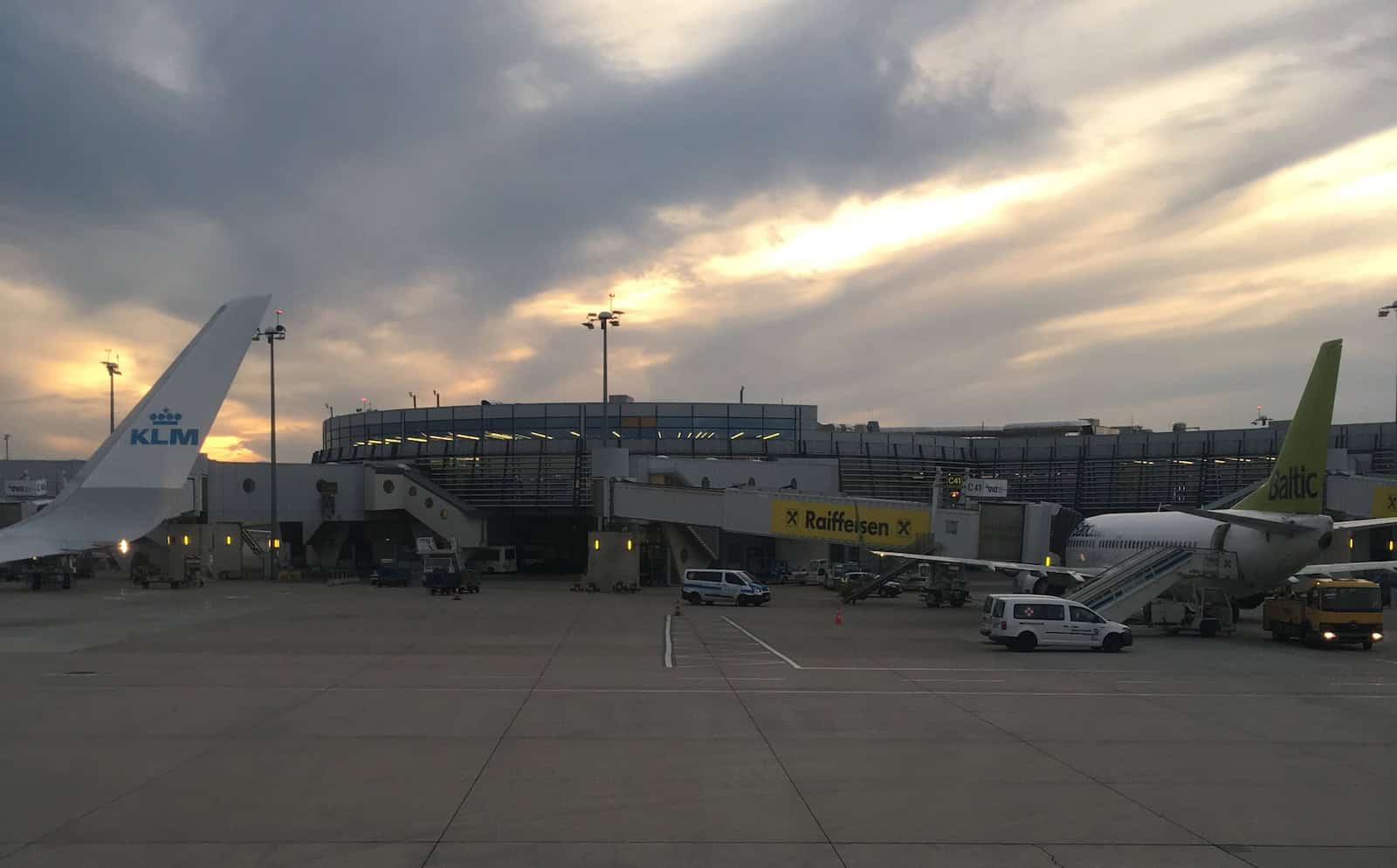
Vienna International Airport (VIE) is around 18 kilometres southeast of the city centre and has direct connections with cities across Europe as well as a number of long-haul destinations.
The flight itself is only part of the journey. Once you land, you still need to get from Vienna Airport to your hotel or accommodation.
Vienna Airport to the city centre
| Transport | Journey | Travel time | Typical price |
|---|---|---|---|
| Railjet | Airport → Wien Hauptbahnhof | around 15 min | from around €4–€5 |
| S-Bahn S7 | Airport → Wien Mitte | around 25 min | from around €4–€5 |
| CAT | Airport → Wien Mitte | check current timetable | €14.90 one way / €24.90 return |
| Airport bus | Several stops in Vienna | depends on route | depends on route |
| Taxi | Direct to your accommodation | around 20–40 min | varies |
CAT disruption in 2026 and 2027
Planning your airport transfer? Read our complete guide to getting from Vienna Airport to the city centre.
Travelling to Vienna by train
If you are travelling from Germany, Czechia, Hungary, Slovakia, Switzerland or another nearby European country, check the train before automatically booking a flight.
Vienna Hauptbahnhof is one of Central Europe’s major railway hubs and has direct international connections in several directions.
| Route | Typical direct journey time |
|---|---|
| Munich → Vienna | around 4 hours |
| Prague → Vienna | around 4 hours |
| Budapest → Vienna | around 2 hours 30 minutes |
| Bratislava → Vienna | around 1 hour |
| Zurich → Vienna | around 8 hours |
Journey times depend on the service and timetable, so always check your exact connection before booking.
ÖBB’s Railjet trains are used on many international routes. They offer First and Second Class, luggage space, Wi-Fi on many services and usually an onboard restaurant or catering service.
The big advantage is where you arrive. Wien Hauptbahnhof is already inside Vienna and has excellent connections with the U-Bahn, S-Bahn, trams and buses. There is no airport transfer to add to your journey.
Night trains to Vienna
Vienna is also one of Europe’s most important night-train hubs.
ÖBB Nightjet services connect the Austrian capital with cities including Amsterdam, Hamburg, Berlin, Zurich, Rome and other European destinations. Depending on the train, you can choose between a regular seat, couchette or sleeping compartment.
A night train will not always be cheaper than flying, but it can replace a hotel night and gets you into central Vienna in the morning.
Read more: Travelling to Vienna by train – routes, tickets and practical tips.
Driving to Vienna
Driving to Vienna makes sense if the city is part of a longer Austrian road trip, if you are travelling with a lot of luggage or if you want to explore places outside Vienna during the same holiday.
| Route | Approximate driving time |
|---|---|
| Munich → Vienna | 4–4½ hours |
| Prague → Vienna | 3½–4 hours |
| Budapest → Vienna | 2½–3 hours |
| Bratislava → Vienna | around 1 hour |
These times do not include traffic jams, breaks or delays during busy travel periods.
Don’t forget the Austrian vignette
| 2026 car vignette | Price |
|---|---|
| 1 day | €9.60 |
| 10 days | €12.80 |
| 2 months | €32.00 |
| Annual vignette | €106.80 |
There are also a few Austrian motorway sections where an additional section toll applies.
Be careful when buying a digital vignette online. The 1-day and 10-day digital vignettes can be valid immediately, but different rules apply to the 2-month and annual versions when bought online as a private consumer.
Do you need a car in Vienna?
Usually not.
Vienna has an extensive public transport network, while parking in and around the centre can be expensive and inconvenient. If Vienna is your only destination, arriving by train or plane and using public transport is normally easier than bringing a car.
If Vienna is the first or final stop on a wider Austrian road trip, a car becomes much more useful.
Getting to Vienna by bus
Long-distance buses are worth checking if price matters more than journey time.
FlixBus and other operators connect Vienna with cities throughout Central and Eastern Europe. Vienna is particularly well connected with Prague, Budapest, Bratislava and Munich.
Prices vary considerably depending on the date and how early you book. As an indication, tickets from Prague can sometimes start at around €14, while Munich–Vienna can start at around €22.
The fastest Prague–Vienna buses take around 3 hours, while Munich–Vienna starts at roughly 4 hours 35 minutes. Road traffic can make bus journey times less predictable, however, and trains are generally more comfortable for longer journeys.
Which is the best way to get to Vienna?
There isn’t one answer for every traveller, but for most journeys the choice is fairly straightforward.
Coming from Germany, Czechia, Hungary or Slovakia?
Check the train first. Vienna’s rail connections are excellent, and arriving directly in the city usually makes it more convenient than flying.
Coming from the UK or elsewhere in Europe?
Flying usually makes sense for longer distances. A direct flight can be the fastest option, especially for a short city break. Compare the complete door-to-door journey rather than the flight time alone.
Coming from outside Europe?
Flying is the practical choice. Vienna International Airport has long-haul services as well as connections through major European hubs.
Travelling around Austria as well?
Consider a car. It becomes much more useful if you want to combine Vienna with rural areas, lakes, mountain regions or smaller towns. For Vienna alone, you probably won’t need one.
Travelling on a tight budget?
Compare bus and advance train fares. Long-distance buses can be particularly cheap from neighbouring countries, although the train is usually more comfortable.
Travelling with children or lots of luggage?
A direct train is hard to beat. There are no airport security procedures or airline luggage restrictions, and you arrive in central Vienna. If you fly, a taxi or airport transfer can be worth the extra cost for a family.
Want to travel overnight?
Check the Nightjet network. A sleeper can save valuable daytime and may replace the cost of one hotel night. Book sleeping compartments early.
Compare the complete journey
Don’t compare transport options using the advertised travel time alone. A one-hour flight can easily become a four- or five-hour journey once airport transfers, check-in, security and waiting time are included.
A four-hour train that takes you from one city centre directly into Vienna may therefore be faster and easier in practice. The same applies to price: compare the ticket, luggage costs, airport transfers, parking and any motorway tolls before deciding which option really offers the best value.