
If you spend enough time in Vienna, you’ll notice a certain face everywhere – on chocolates, fridge magnets, and even the walls of imperial palaces. Meet Empress Elisabeth of Austria, better known as Sisi: half woman, half legend. She was adored, misunderstood, endlessly restless, and even today she feels strangely alive in Vienna’s cultural memory.
But who was she really?
From Bavarian princess to reluctant empress
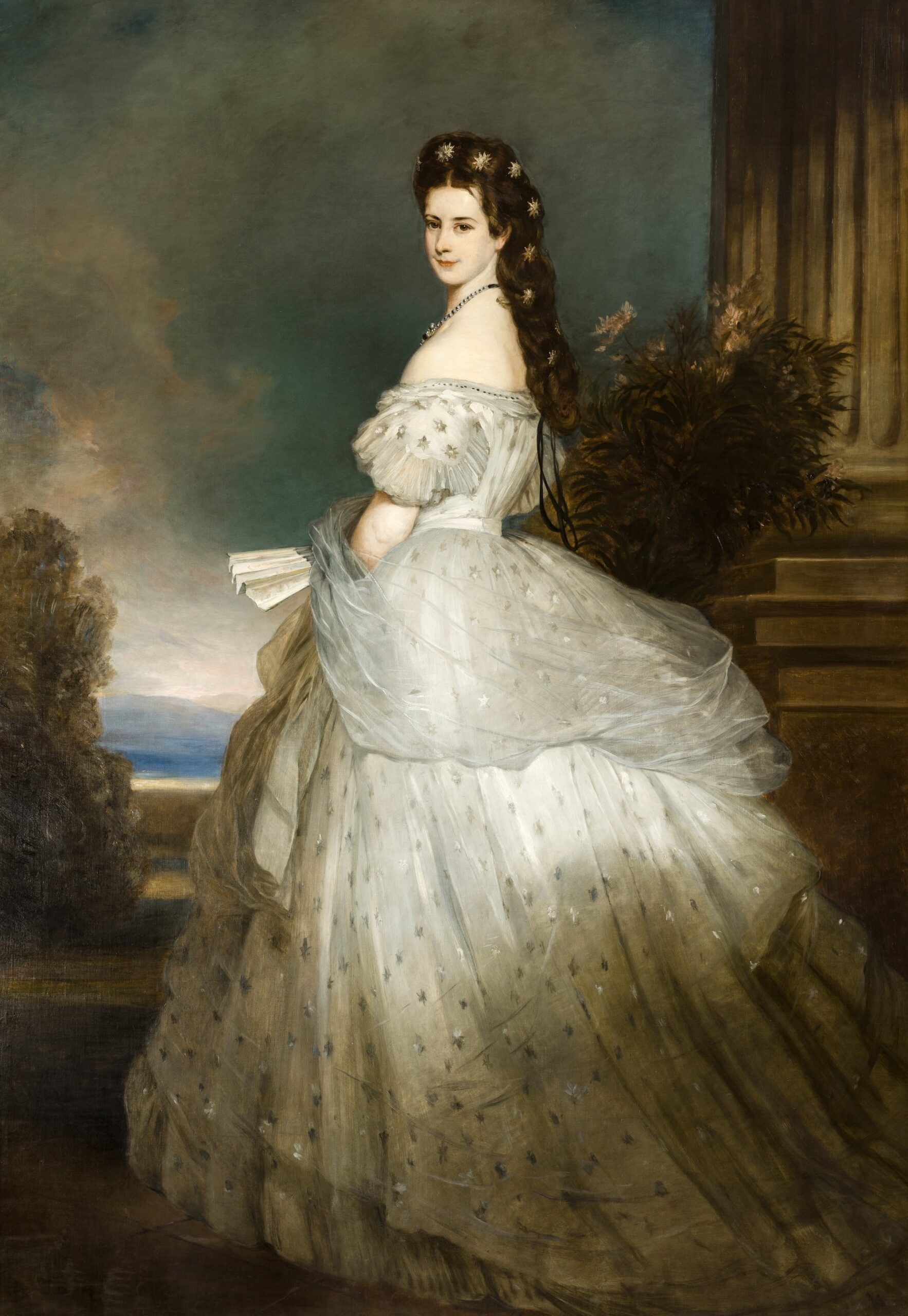
Franz Xaver Winterhalter, Empress Elisabeth, Photo: Áment Gellért / Belvedere, Vienna
The work is part of the Belvedere’s Open Content Policy, available for download and free of copyright restrictions.
Elisabeth was born in 1837 in Munich into a minor branch of the Bavarian royal family. She grew up outdoors, horse riding and hiking rather than learning the strict etiquette expected of royal daughters. Fate intervened when Emperor Franz Joseph was meant to meet her older sister but promptly fell in love with sixteen-year-old Elisabeth instead.
The wedding took place in Vienna’s Augustinerkirche in 1854. What began as a fairytale soon felt more like a gilded cage. The Austrian court was rigid, formal, and ruled by Franz Joseph’s overbearing mother, Archduchess Sophie. For the free-spirited Sisi, life behind palace walls quickly became suffocating.
Beauty, obsession, and rebellion
Sisi became famous across Europe for her beauty – and for the extreme discipline behind it. Her hair reached down to her ankles, she followed strict diets, rode horses like a professional, and trained obsessively to keep her waist impossibly small. Her dresses were so tight that modern visitors to the Sisi Museum still gasp in disbelief.
Perfection came at a price. She struggled with melancholy and what we would now call depression. After losing her first daughter and later her only son, Crown Prince Rudolf, she withdrew further into travel, writing, and endless attempts to escape the rituals of court life.
In a time when royal women were expected to smile and wave, Elisabeth quietly rebelled – not through speeches or politics, but by disappearing. She spent months at a time away from Vienna, exploring Hungary, Corfu, and the Mediterranean.
A tragic end
Elisabeth’s restless life ended far from home. In September 1898, while walking along the shores of Lake Geneva under a quiet morning sun, she was attacked by an Italian anarchist, Luigi Lucheni, who drove a sharpened file into her chest. At first, she did not realise she had been fatally wounded and continued walking towards her boat before collapsing moments later. The Empress of Austria had lived a life pursued by expectations, and in a cruel twist of fate, death found her while travelling incognito – finally enjoying the freedom she had always sought.
Her assassination sent shockwaves through Europe. Newspapers mourned her as the “sad Empress,” artists romanticised her beauty, and the public transformed her private sorrow into a national myth. In many ways, that tragic moment in Geneva marked the beginning of her afterlife as a legend – an image shaped less by who she was and more by what the world wanted her to be.
More than a century later, Sisi still resists easy interpretation. Was she a victim of her era’s rigid conventions, a misunderstood artist, or a restless soul caught between duty and desire? Perhaps all of these – and it is precisely this tension that keeps her story alive, shimmering somewhere between history and myth.
Did you know?
Sisi’s assassin, Luigi Lucheni, never intended to kill her personally. The impoverished Italian anarchist wanted to strike down “any royal” as a symbol of privilege and happened to find the Empress unguarded in Geneva. He was sentenced to life in prison – furious that the death penalty had just been abolished – and later took his life in 1910. In a macabre twist, his head was preserved for scientific study and only laid to rest decades later.
Where to follow in Sisi’s footsteps in Vienna
Vienna still carries traces of Elisabeth almost everywhere you go. Here are some of the best places to encounter her story – at least in spirit.
Sisi Museum & Imperial Apartments (Hofburg Palace)
If Schönbrunn was Sisi’s reluctant stage, then the Hofburg Palace was her daily reality – the beating heart of imperial Vienna and the centre of the Habsburg world. Hidden within its grand façades lies the Sisi Museum, one of the most revealing collections dedicated to any European royal. It tells the story not of a fairy-tale empress, but of a woman both admired and trapped by her own legend.
The museum begins with the Imperial Silver Collection, a glittering prelude to the life of ceremony that defined the monarchy. Then you step into Elisabeth’s world: more than 300 personal items, from her travelling medicine chest and parasols to her delicate fans, gloves, and handwritten poems. One of the most haunting exhibits is a set of her tight-laced riding jackets – their impossibly narrow waists silently testify to the discipline and pressure she imposed on herself.
Her dressing room feels unexpectedly intimate. Here she began her elaborate daily beauty ritual, which could last several hours: washing her hair in a mixture of cognac and egg yolk, being laced into corsets, and sitting through hours of brushing by her ladies-in-waiting. The enormous mirror and hair-care tools on display give you a glimpse of that routine in meticulous detail.
Step next into the bedroom she shared with Emperor Franz Joseph – or rather, nearly shared. The Emperor’s adjoining study shows his neat, disciplined character, while Elisabeth’s chamber, with lighter colours and fewer decorations, hints at her preference for simplicity and personal space. Between the rooms lies an almost symbolic distance, the quiet divide between duty and freedom.
What makes the museum particularly powerful is its tone: it doesn’t glorify her, but tries to understand her. You see letters, portraits and even her gymnastic rings suspended from the ceiling, reminding visitors that this was a woman who pushed against the boundaries of her role.
By the time you leave the Hofburg, Sisi feels less like a distant historical figure and more like a restless, modern spirit – a woman who lived under the weight of beauty, expectation, and endless longing.
Tip: Go early in the morning or late afternoon – it’s quieter and the imperial rooms feel eerily alive.
Schönbrunn Palace

Vienna’s grand summer residence of the Habsburgs, Schönbrunn Palace, may look like the setting for a perfect imperial fairytale – but for Elisabeth, it was often just another gilded stage she longed to escape. She disliked the endless formalities and carefully choreographed routines of court life, yet the palace also offered her brief moments of solitude and freedom.
Visitors can still step into the private apartments she once occupied, far more modest than the ceremonial halls nearby. Her bedroom, with its simple walnut furniture and personal writing desk, reflects a taste that was surprisingly restrained for an empress. In her adjoining dressing and exercise room, she began her rigorous daily beauty and fitness routine – performing gymnastics on wall bars, using weights, and following a strict diet long before wellness became fashionable.
Look closely, and you’ll notice details that reveal the woman behind the legend: the portrait of her favourite horse, her travel maps, the mirrors placed at just the right angle to reflect her famously long hair. These rooms feel almost intimate, especially compared to the opulent Great Gallery and Hall of Mirrors where court balls and receptions once took place.
Outside, the vast Schönbrunn gardens offered her the sense of space she missed inside the palace. She often walked alone among the neatly trimmed hedges and rose parterres, escaping towards the Gloriette on the hill for a glimpse of Vienna in the distance – a city she loved and fled from in equal measure.
Kaisergruft (Imperial Crypt)
Beneath the modest Capuchin Church, far from the chandeliers and gold leaf of the imperial palaces, lies one of Vienna’s most quietly powerful places: the Kaisergruft, or Imperial Crypt. This dimly lit burial vault has been the final resting place of the Habsburgs since the 17th century – over 140 members of Europe’s most powerful dynasty, lined up in ranks of elaborately carved sarcophagi.
Here you’ll find Emperor Franz Joseph, their only son Crown Prince Rudolf, and of course Elisabeth herself. Her coffin, simple compared to the baroque excess of her ancestors, sits between those of her husband and son – an arrangement that would have amused her. Considering how much of her life she spent trying to escape both court and convention.
Visitors still leave fresh flowers and handwritten notes on her tomb, as if the restless empress might somehow read them. The air smells faintly of candle wax and history; every footstep echoes against stone walls that have heard centuries of whispered reverence. It’s oddly touching, and just a little morbid – Vienna has always been good at that combination.
If you linger for a moment, you might catch yourself smiling at the irony: the woman who spent her life running from ceremony now lies at the heart of it forever, surrounded by generations of the very family she once tried to flee.
Volksgarten Elisabeth Monument
A peaceful spot in the city centre. The statue of Sisi in white marble shows her as Vienna remembers her: elegant, distant, and forever young. On warm spring days, the scent of roses adds an almost cinematic atmosphere.
Sisi experiences and tours
Several walking tours and museum packages let you trace her life through Vienna. Some combine palace visits with VR experiences or themed coffee breaks (yes, there’s a Sisi cake too). It’s a gentle way to connect history with everyday Vienna.
Want to go deeper? Try a Sisi-themed guided tour or combo ticket that includes Schönbrunn and the Hofburg.
Why Vienna still loves Sisi
Elisabeth wasn’t just beautiful – she was complex, modern before her time, and often miserable in her gilded cage. Yet she captured imaginations across Europe. To Hungarians, she was a political ally who championed their autonomy. To Austrians, she remains a tragic romantic figure.
Films, books, operas and musicals have all retold her story – not always accurately, but always passionately. Even recent productions like Corsage show how her myth keeps evolving with each generation.
And yes, she’s still a commercial icon – you can find her on everything from perfume bottles to snow globes.
Fun facts and curious details
- Her hair reportedly took three hours a day to brush.
- She had a gym built in the Hofburg – a rare sight in 19th-century palaces.
- She spoke fluent Hungarian, a language she learned out of affection for the people.
- A 2024 auction of her personal items fetched astonishing prices: a riding crop sold for €16,900 and a velvet jacket for over €60,000.
Visiting Vienna through Sisi’s eyes
If you follow Sisi’s trail, you’ll also see Vienna itself in a different light – half imperial splendour, half personal melancholy. Her story runs parallel to the city’s transformation from empire to modern capital.
Whether you admire her for her independence, her beauty, or her tragic life, one thing is certain: Vienna wouldn’t be quite the same without her.
Plan your Sisi journey
- Start at the Hofburg and its Sisi Museum.
- Continue to Schönbrunn Palace and the Volksgarten.
- Finish at the Kaisergruft for a quiet, reflective end.
If you still haven’t had enough, book a Sisi-themed tour – and maybe enjoy a slice of Sisi-Torte afterwards. Even empresses, after all, needed a little indulgence.