
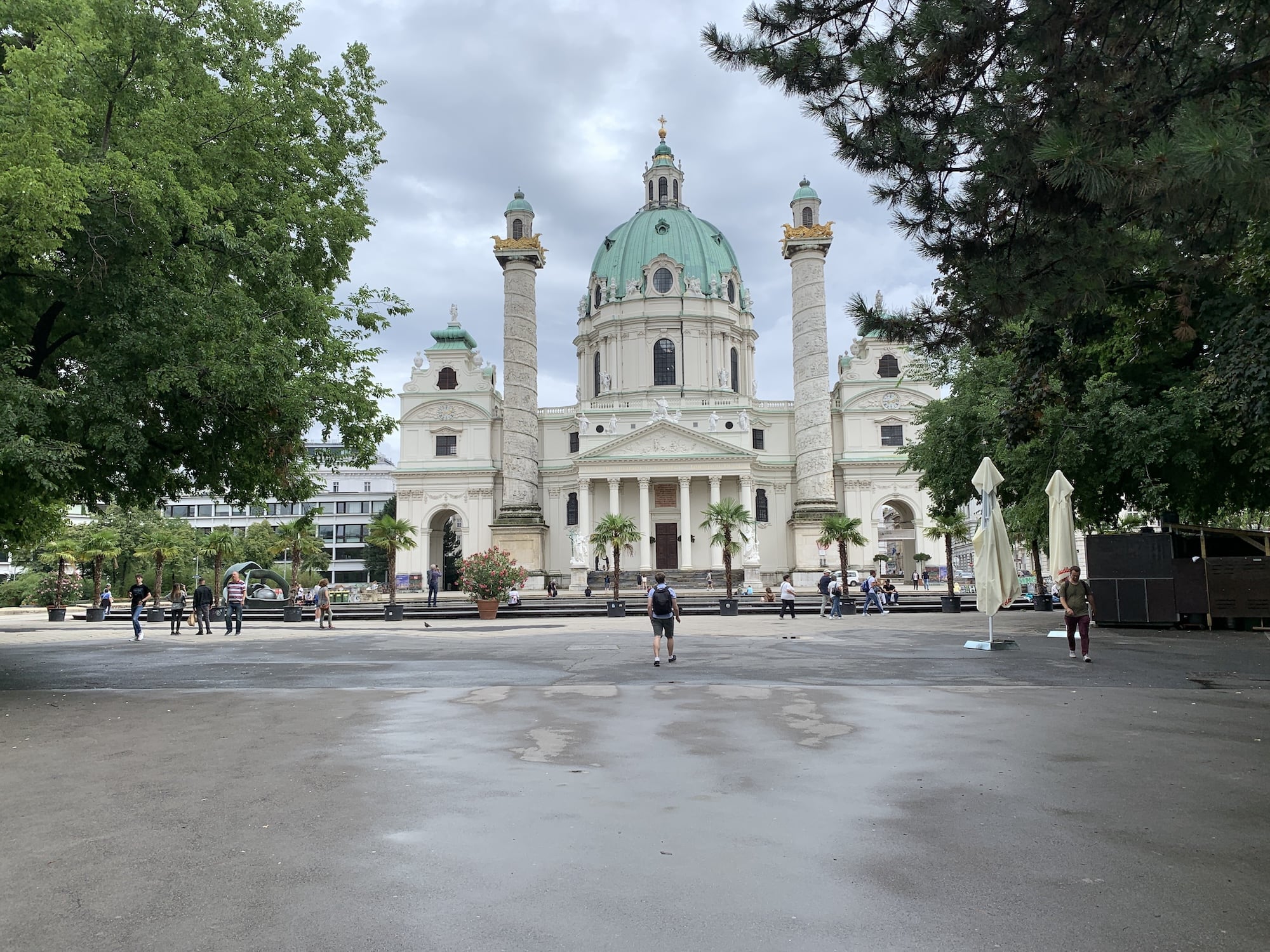
The Karlskirche is one of those buildings that effortlessly draws your eye. Its grand green dome rises high above Karlsplatz, gleaming in the sunlight as if trying to claim the city’s attention. Even if you’re not particularly into churches (I’m not either), it’s hard not to be impressed.
I first stumbled upon it one summer afternoon in Vienna, almost accidentally. I’d just grabbed a coffee at Café Museum, looked up, and there it was – white, majestic, and full of detail. Since then, I’ve returned often, not to pray, but to pause.
A little history
The Karlskirche was commissioned by Emperor Charles VI as a gesture of gratitude for the end of the plague in 1713. It was dedicated to St Charles Borromeo, the patron saint of the sick. The design came from the celebrated Baroque architect Johann Bernhard Fischer von Erlach, and after his death, his son Josef Emanuel completed the church in 1737.
What makes the Karlskirche truly fascinating is its blend of influences. The portico resembles a Greek temple, while the two tall columns beside it recall Rome’s Trajan’s Column. Together, they symbolise faith and steadfastness. The dome and interior are pure Austrian Baroque, but you’ll also spot subtle Byzantine and Ottoman touches — a nod to Vienna’s historic role as a bridge between East and West.
The Karlskirche was also built as a “votive church”: a sacred promise made by an emperor. It tells a story not only of faith but also of power and ambition, where religion, art, and politics intertwined.
Inside the Karlskirche
Step inside, and the atmosphere shifts. The light feels softer, almost silver, filtering gently through the dome windows. There’s the faint scent of old wood and marble dust, and every footstep echoes.
The highlight is the vast 72-metre-high dome decorated with frescoes by Johann Michael Rottmayr, depicting St Charles Borromeo praying for the end of the plague. The colours and movement are so vivid that it’s easy to forget they’re nearly three centuries old.
For years, visitors could take a panoramic lift to view the frescoes up close. That lift was removed in 2022 and replaced with a far more engaging tour. The new route takes you through several areas of the Baroque church, including a viewing platform above the main entrance with sweeping views over Vienna’s inner city. Along the way, you’ll see a 2.48-metre scale model of the Karlskirche (1:28), showing Fischer von Erlach’s original design.
The restored treasury is also open to visitors and is an unexpected highlight. Among silver chalices and centuries-old manuscripts, you can almost sense the splendour of imperial Vienna. Soon, the former imperial box will also reopen, offering a rare perspective over the altar once reserved for the Habsburgs.
Opening hours and tickets
The Karlskirche is open daily and pairs perfectly with a stroll around Karlsplatz or the nearby Naschmarkt. Your ticket also includes access to the panoramic viewing area inside the dome.
Opening hours:
Monday–Saturday: 9:00 – 18:00
Sundays and public holidays: 11:00 – 19:00
Admission:
Adults: €9.50
Students: €6
Children (10–17): €5
Children under 10: free
Tip: buy your ticket online in advance. The price is the same, but you can skip the queue.
Concerts at the Karlskirche
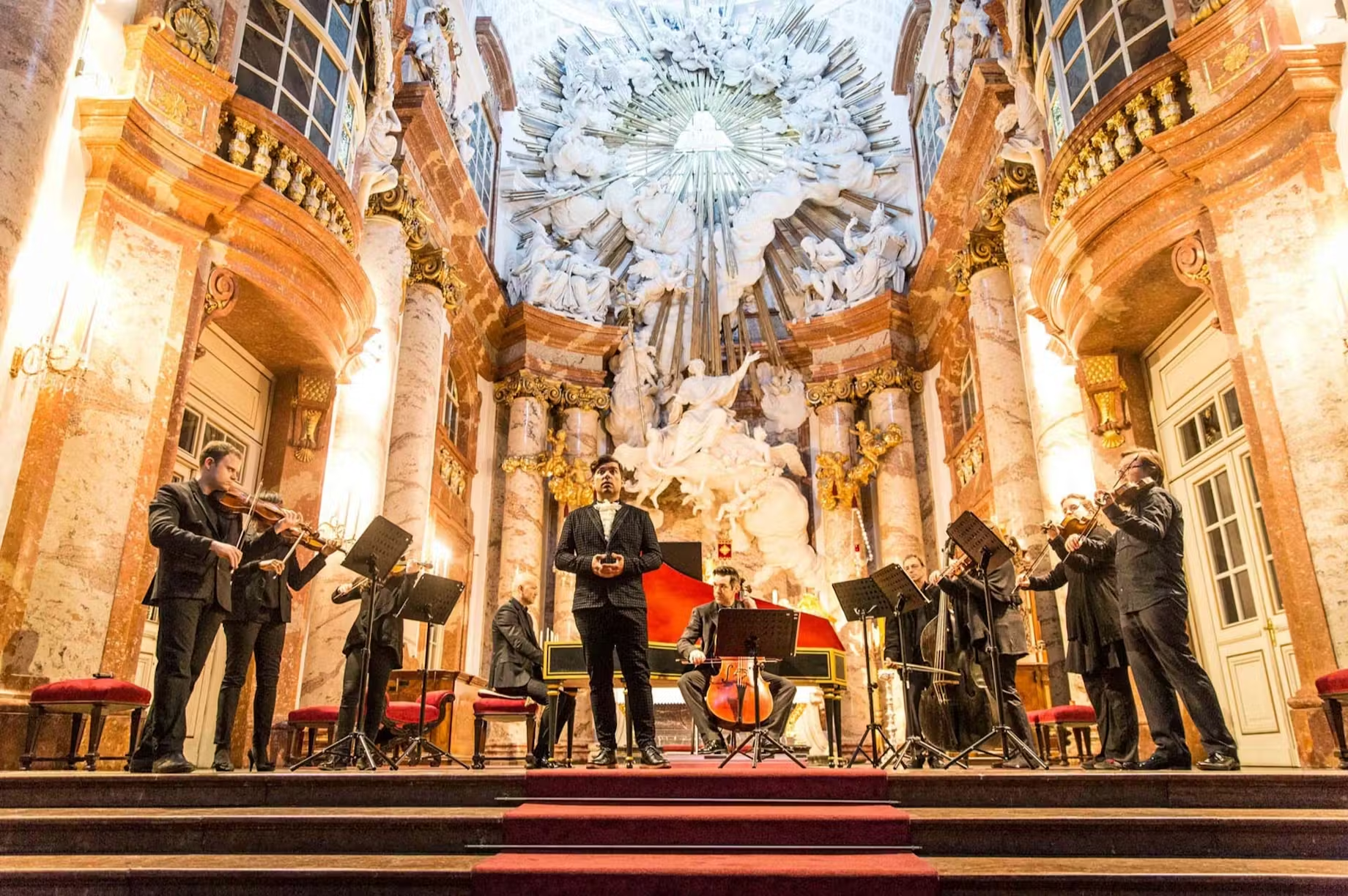
By night, the Karlskirche transforms. The chandeliers dim, the marble walls glow softly, and the first notes of Vivaldi’s Four Seasons fill the air. Almost every evening, the ensemble Orchestra 1756 performs here on authentic 18th-century instruments, creating a sound as close as possible to what Vivaldi himself would have heard. Their precision and warmth are enhanced by the church’s natural acoustics — rich, resonant, and almost ethereal.
Buy tickets for a classic concert in the Karlskirche
The sound behaves differently here than in a concert hall: the high dome and marble surfaces create a soft echo that makes each violin note linger. It’s intimate and grand at once.
I once attended a December performance. Outside, the air smelled of mulled wine and roasted chestnuts from the Christmas market. Inside, there was a hush — only the rustle of coats and the first delicate notes of the violin. For a moment, the city disappeared.
Practical concert info
Duration: around 75 minutes
Tickets from: €34
Repertoire:
Usually, The Four Seasons, sometimes complemented by works from Mozart, Haydn, or Bach.
Dress code:
There’s no formal dress code, but most people opt for smart casual — think neat trousers or a dress, perhaps a blazer or scarf. Evening wear isn’t required, but a little polish suits the setting.
Temperature:
The Karlskirche isn’t heated like a modern concert hall. It stays pleasantly cool in summer but can be chilly in winter — bring a jumper or wrap, especially for evening performances.
Arrival:
Doors open 30–45 minutes before the concert. Arrive early if you can — the central seats offer the best acoustics.
Photography:
Photos are welcome before and after, but best avoided during the concert itself. The atmosphere is too beautiful to interrupt with a glowing screen.
Getting there and nearby sights
The Karlskirche stands on Karlsplatz, one of Vienna’s liveliest squares. It’s easy to reach by:
- Metro: U1, U2 or U4 – Karlsplatz stop
- Tram: lines 1, 62 or D – Karlsplatz/Oper stop
- On foot: about 10 minutes from the State Opera
Across the square is the Musikverein, home of the Vienna Philharmonic’s famous New Year’s Concert. A short walk away you’ll find the Secession building with Klimt’s Beethoven Frieze and the Technical University of Vienna.
Local tip: pair your visit with a coffee at Café Museum or a stroll through the Naschmarkt — the perfect mix of imperial elegance and everyday Viennese life.
Why the Karlskirche is worth visiting
What makes the Karlskirche special is that it’s not just a relic of the past. It feels alive. By day you admire its art and architecture; by night it fills with music and warmth.
I often find myself returning here, especially in winter. The Christmas lights reflect in the pond before the church, and the air carries the scent of chestnuts and cinnamon. Standing there, watching the dome glow against the night sky, I’m reminded once again what makes Vienna so captivating: its effortless blend of beauty and atmosphere.
Practical information
Address: Karlsplatz 10, 1040 Vienna
Website: www.karlskirche.at
Metro: U1, U2, U4 – Karlsplatz stop
Average visit duration: 1–1.5 hours
Accessibility: partly wheelchair accessible (lift to mid-level, not to the dome)