
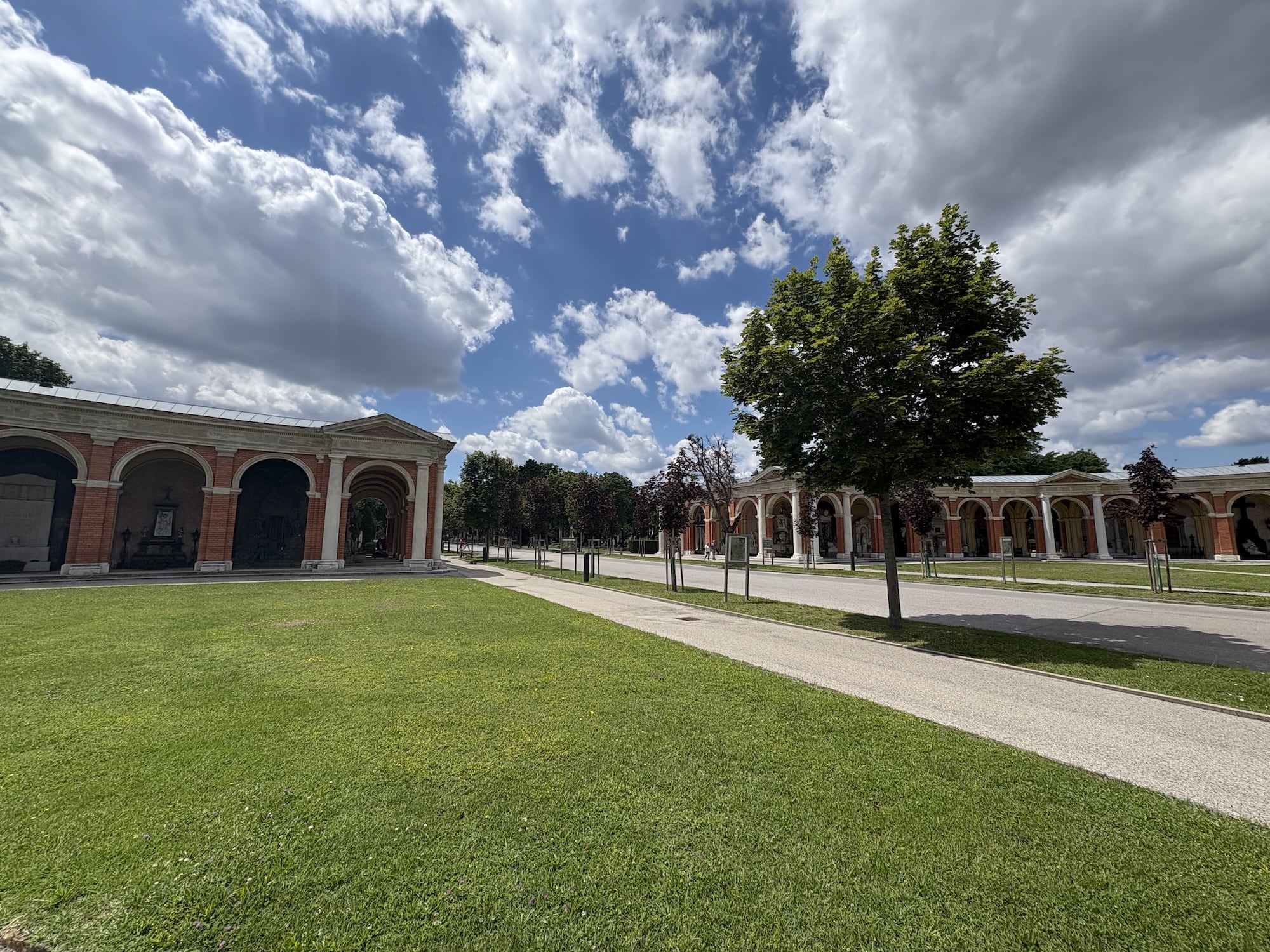
When planning a trip to Vienna, most visitors immediately think of Schönbrunn Palace, St. Stephen’s Cathedral, or the city’s famous coffee houses. Yet one place that rarely appears on a first-time visitor’s itinerary turns out to be one of the best: Vienna Central Cemetery (Zentralfriedhof).
That may sound surprising. After all, a cemetery is probably not the first place that comes to mind when planning a city break. But the Zentralfriedhof is far more than a burial ground. Covering almost 2.5 square kilometres (0.96 square miles), it is one of the largest cemeteries in Europe and the final resting place of more than three million people.
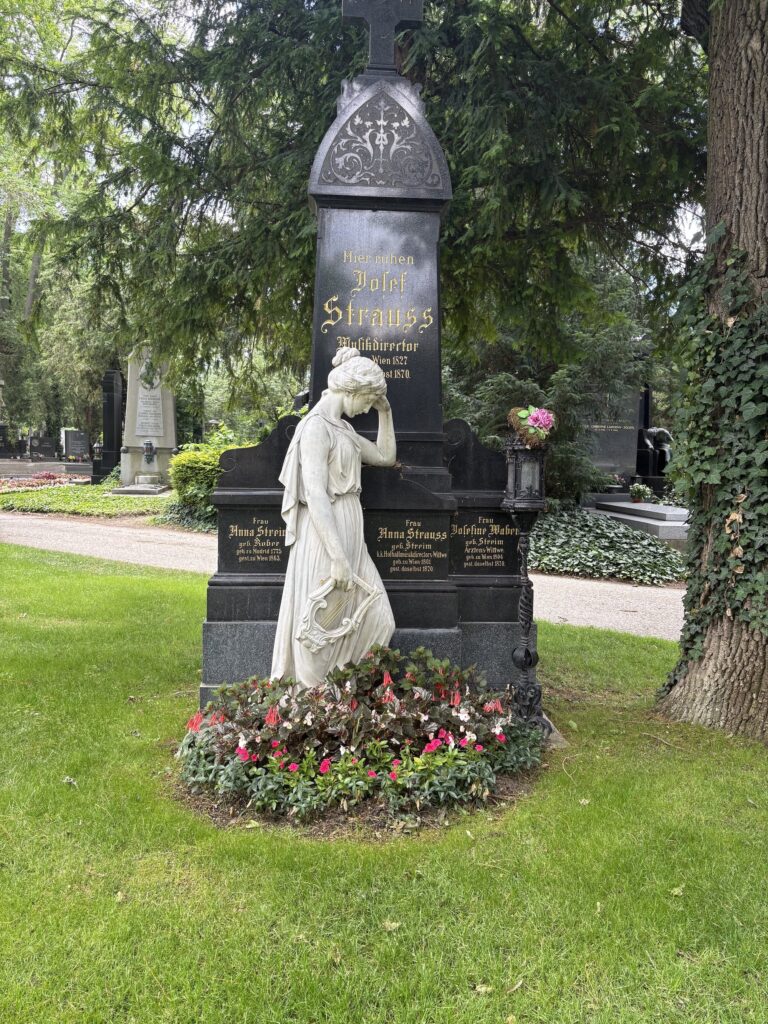
Visitors come here for many reasons. Some want to see the graves of legendary composers such as Ludwig van Beethoven, Johannes Brahms and Johann Strauss II. Others visit the grave of Austrian pop icon Falco, admire the magnificent Karl Borromäus Church, or simply enjoy the calm of one of Vienna’s finest green spaces.
The cemetery also reveals an entirely different side of Vienna. Few cities have such a distinctive relationship with death. Respect, tradition, and history are combined with a sense of humour that locals refer to as Wiener Schmäh—a dry, witty style that even finds its way into the cemetery’s surprisingly popular souvenir shop.
In this guide, you’ll find everything you need to know before visiting Vienna Central Cemetery: how to get there, which entrance to use, the most famous graves, the highlights you shouldn’t miss and the practical information that will help you make the most of your visit.
Why Vienna Central Cemetery is so special
Vienna Central Cemetery officially opened in 1874, at a time when Vienna’s existing cemeteries could no longer accommodate the city’s rapidly growing population. When it was first built, the cemetery stood well outside the city limits, and many Viennese residents were far from enthusiastic. It was considered too remote, and the idea that almost everyone would eventually be buried in one enormous central cemetery was highly controversial.
More than 150 years later, that criticism has long disappeared. Vienna has expanded around the cemetery, and today the Zentralfriedhof draws hundreds of thousands of visitors every year—not just to pay their respects, but to explore the architecture, the history, and the famous honorary graves.
With an area of almost 2.5 square kilometres (0.96 square miles), the cemetery is enormous. You can easily spend several hours wandering through its wide avenues without seeing everything. Well over three million people are buried here—significantly more than Vienna’s current population of around two million. Locals therefore like to joke that the Zentralfriedhof has more “residents” than the city itself.
What makes the Zentralfriedhof genuinely worth your time is its diversity. Besides the Catholic sections, you’ll also find Protestant, Orthodox, Jewish, Muslim, and Buddhist burial grounds; military cemeteries; and memorials dedicated to victims of war. Artists, scientists, politicians, musicians, and many of Austria’s most influential historical figures all rest here.
Despite its solemn purpose, Vienna Central Cemetery feels surprisingly peaceful and full of life. Towering trees, broad avenues, and beautifully maintained green spaces create an atmosphere that often feels more like a park than a traditional cemetery.
How to get to Vienna Central Cemetery
Vienna Central Cemetery is located in Simmering, Vienna’s 11th district, around 8 kilometres (5 miles) southeast of the historic city centre. Thanks to Vienna’s excellent public transport network, getting there is easy and usually takes about 25 to 30 minutes.
Although the cemetery lies outside the main tourist area, it’s well worth the trip. Given its size and the number of things to see, it’s best to set aside at least half a day if you want to explore more than just the highlights.
By tram
The easiest and most popular way to reach the Zentralfriedhof is by tram line 71. The tram departs from Schwarzenbergplatz and stops directly in front of Gate 2 (Tor 2), the cemetery’s main entrance. From there, it’s just a short walk to the honorary graves, Karl Borromäus Church, the visitor centre and the Bestattungsmuseum.
For locals, tram 71 is more than just another tram line. For generations, Viennese people have used the expression “Er fährt mit dem 71er” (“He’s taking the 71”) as a humorous way of saying that someone has passed away. It’s a perfect example of Wiener Schmäh—Vienna’s famously dry and often dark sense of humour.
By S-Bahn
Another convenient option is the S-Bahn. Wien Zentralfriedhof station is located on the western side of the cemetery and is served by several suburban train lines.
Depending on which part of the cemetery you want to visit, this can be a practical alternative. However, if you’re visiting for the first time, Gate 2 remains the best starting point.
By car
Vienna Central Cemetery is also easy to reach by car. Parking is available near several entrances, including Gate 2.
Please note that these parking areas are located within one of Vienna’s short-term parking zones (Kurzparkzone). From Monday to Friday between 9:00 am and 10:00 pm, parking is limited to two hours, and parking fees apply. You can pay using a parking ticket or Vienna’s Handyparken mobile parking system.
Parking is free and unrestricted during the evening, on weekends, and on Austrian public holidays.
If you plan to spend several hours exploring the cemetery, visiting the museum or photographing the famous graves, public transport is usually the easier option.
Which entrance should you choose?
With several entrances spread across the vast cemetery, choosing the right one will save you a considerable amount of walking.
For most visitors, Gate 2 (Tor 2) is by far the best choice.
Here you’ll find:
- the impressive main entrance;
- the visitor centre;
- the souvenir shop;
- Karl Borromäus Church;
- the famous honorary graves (Ehrengräber);
- the starting point for the most popular walking routes.
If your main goal is to visit Falco’s grave, however, Gate 3 (Tor 3) is a much better option. His grave is located in Group 40, Grave 64, just a five-minute walk from this entrance. From Gate 2, the walk takes approximately 25 minutes.
Famous graves at Vienna Central Cemetery
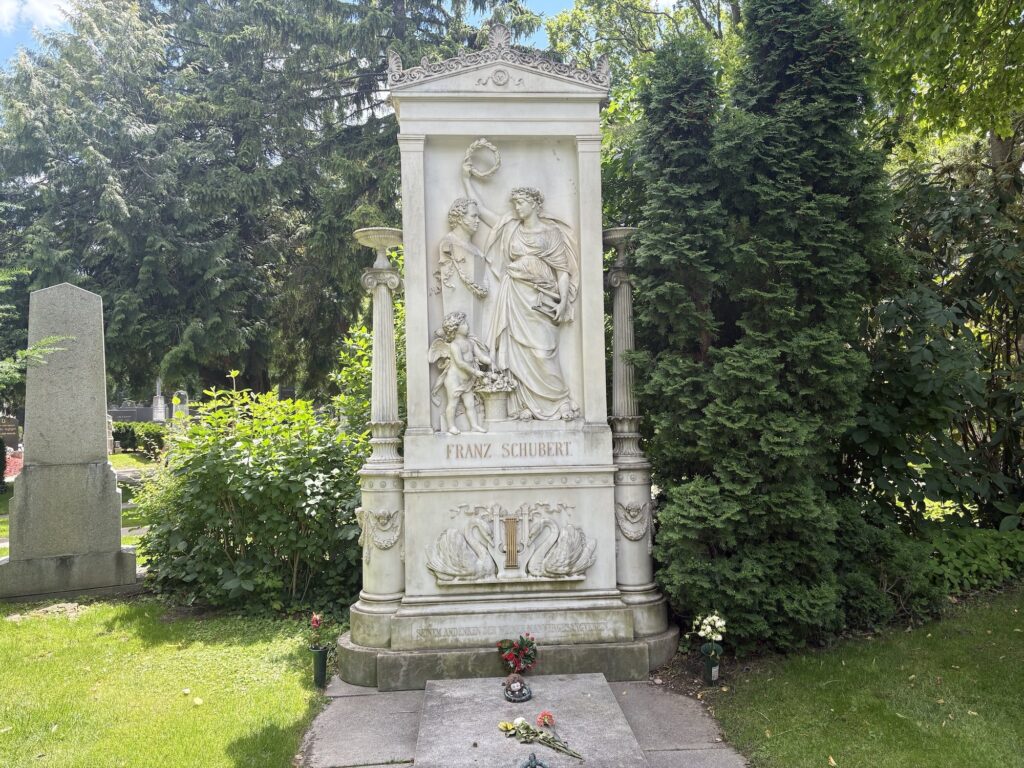
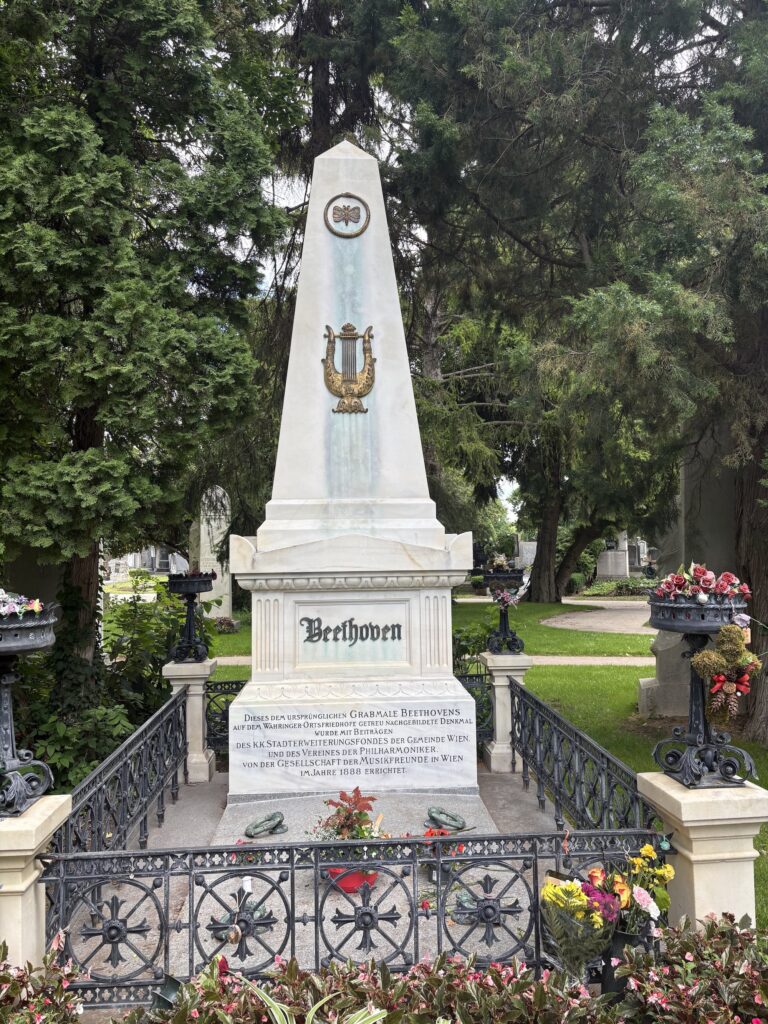
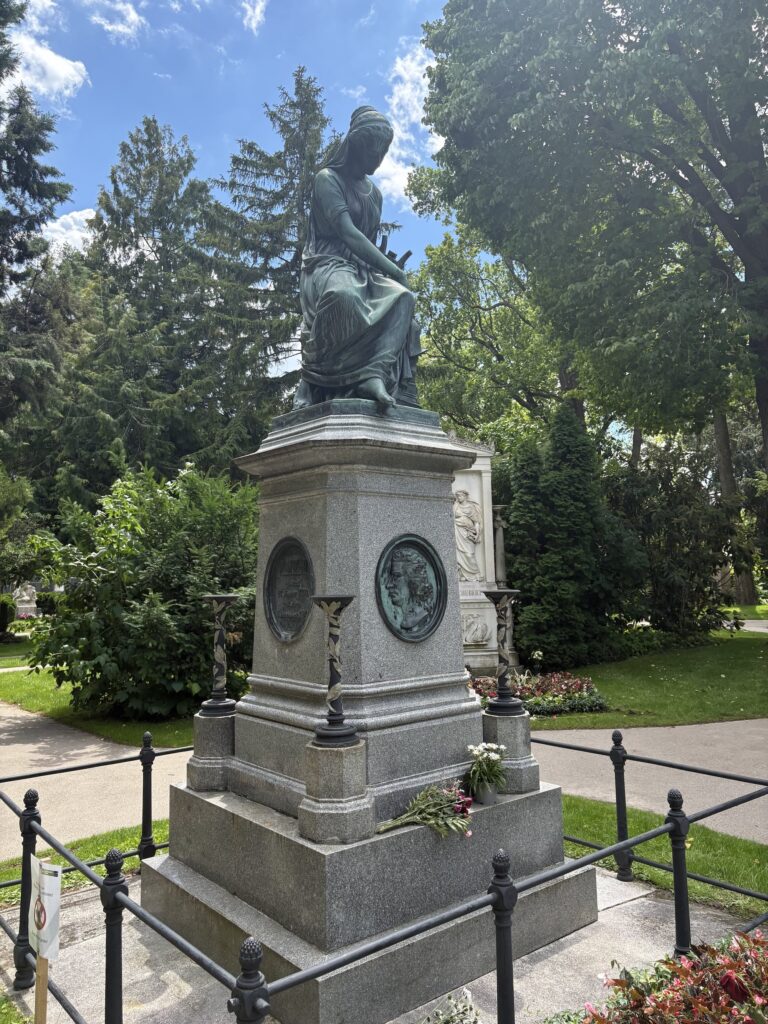
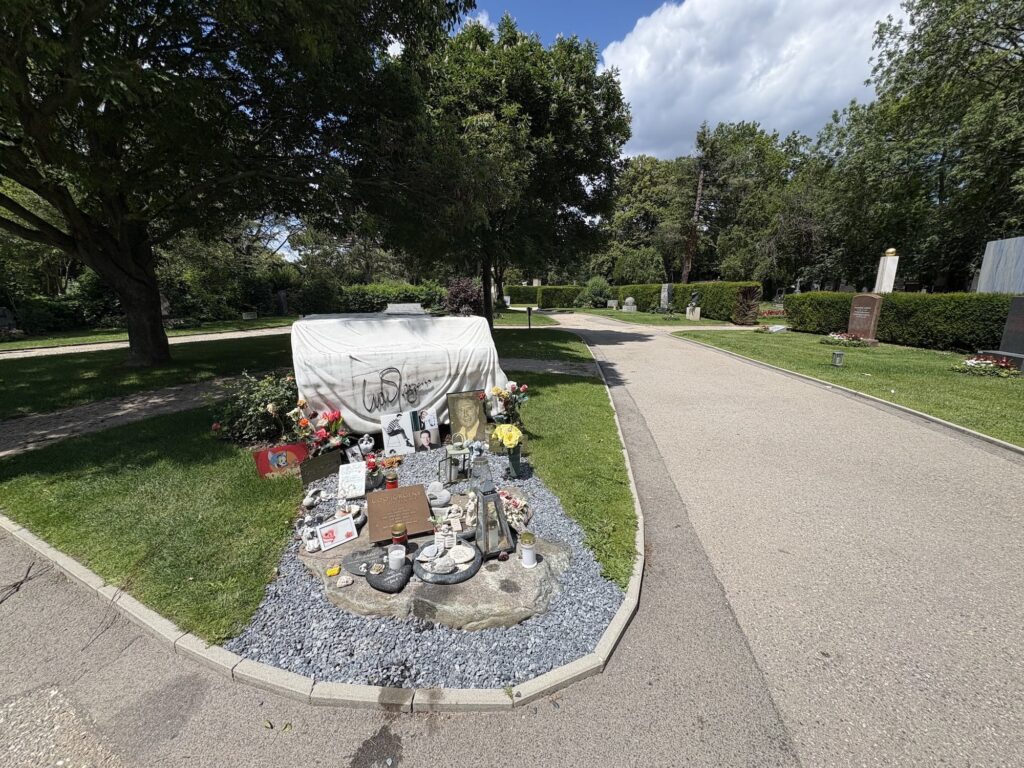
One of the main reasons people visit Vienna Central Cemetery is to see the graves of Austria’s most well-known composers, musicians, politicians, and artists. The honorary graves (Ehrengräber) are clustered around Karl Borromäus Church and are easy to reach from Gate 2.
Ludwig van Beethoven (1770–1827)
Although Beethoven was born in what is now Germany, he spent much of his life in Vienna, where he composed some of the greatest works in classical music, including the Ninth Symphony and the Moonlight Sonata. His grave is one of the most visited in the honorary section and is almost always covered with fresh flowers left by admirers from around the world.
Johannes Brahms (1833–1897)
Johannes Brahms lived in Vienna for more than two decades and became one of the leading composers of the Romantic period. His grave is just a short walk from Beethoven’s and, together with Schubert and Strauss, forms a kind of composers’ quarter that music lovers make a special trip to see.
Franz Schubert (1797–1828)
Born in Vienna, Franz Schubert composed more than 600 works before his death at just 31. He was originally buried at Währing Cemetery, but his remains were later transferred to Vienna Central Cemetery at the request of admirers who wanted him alongside Beethoven. Today, his grave is one of the most visited in the honorary section.
Johann Strauss II (1825–1899)
No composer is more closely associated with Vienna than Johann Strauss II, the “Waltz King.” His composition The Blue Danube remains one of the most recognisable pieces of music in the world and is performed every year at the Vienna New Year’s Concert. His grave is among the most photographed at the cemetery.
Udo Jürgens (1934–2014)
Singer, songwriter, and pianist Udo Jürgens is another Austrian legend buried in the honorary section. With classics such as Griechischer Wein and Ich war noch niemals in New York, he became one of the most successful German-speaking artists of all time. His grave continues to attract fans from across Europe.
Falco (1957–1998)
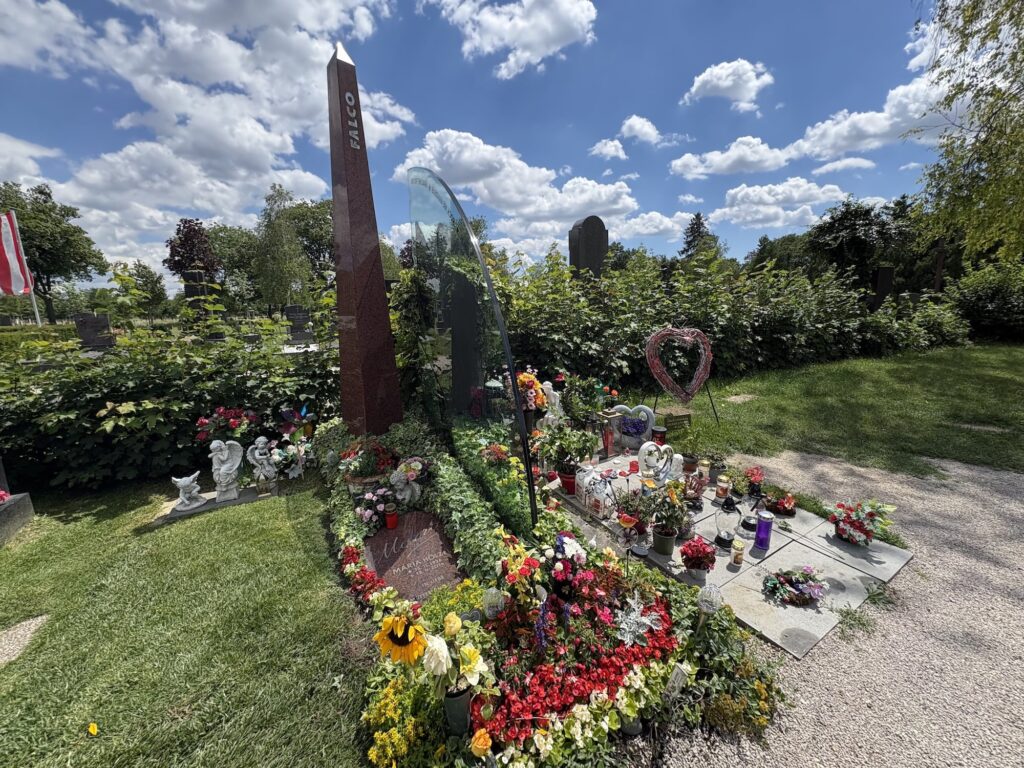
The cemetery’s most famous modern grave belongs to Falco, the only German-speaking artist ever to reach No. 1 on the US Billboard Hot 100 with Rock Me Amadeus.
One thing catches many visitors off guard: Falco is not buried in the main honorary section near Karl Borromäus Church. His grave is in Group 40, Grave 64, close to Gate 3—about a five-minute walk from that entrance, or approximately 25 minutes from Gate 2.
His memorial is almost always covered with flowers, candles, and personal messages left by fans from all over the world, making it one of the cemetery’s most visited spots.
What about Mozart?
Many visitors arrive expecting to find Wolfgang Amadeus Mozart’s grave at Vienna Central Cemetery—and leave confused.
Mozart is not buried here. He was laid to rest in St. Marx Cemetery (St. Marxer Friedhof) in 1791, where a memorial now marks his presumed burial site.
At Vienna Central Cemetery, you’ll find an impressive memorial dedicated to Mozart among the other great composers. Because of its prominent location, many visitors mistake it for his actual grave.
Many more famous Austrians
These are just a few of the well-known figures buried here. As you walk through the grounds, you’ll come across graves of architects, scientists, politicians, actors and artists who shaped Austrian history. The Zentralfriedhof is, in many ways, an open-air museum—one where you keep finding someone new around every corner.
Bestattungsmuseum: Vienna’s most unusual museum
A museum dedicated to funerals and burial traditions may not sound like an obvious stop during a city trip, but the Bestattungsmuseum (Funeral Museum) is one of Vienna’s least-known gems.
Located right next to Gate 2, beside the main entrance to Vienna Central Cemetery, the museum is small enough to visit in under an hour—yet it gives you a real window into one of the city’s oldest traditions.
Rather than focusing solely on mourning, the museum explores how death has shaped Viennese culture for centuries. Through historical funeral carriages, mourning attire, original documents and funeral artefacts, you’ll discover how elaborate funerals once reflected a person’s social status and why Vienna became famous for its distinctive funeral traditions.
One of the museum’s most telling themes is the Viennese attitude towards death. While death remains a difficult subject in many countries, Viennese culture has long combined respect with a dry sense of humour—the Wiener Schmäh—and the exhibition leans into that rather than shying away from it.
The museum also highlights the role of Bestattung Wien, Vienna’s municipal funeral service, which has been organizing funerals for more than a century and continues to play an important role in the city’s traditions today.
It’s a compact museum, but it adds genuine context to a walk through the Zentralfriedhof and helps explain why Vienna’s cemeteries are much more than places of remembrance.
Tip: Your museum ticket also gets you into the museum shop, where you’ll find one of Vienna’s most unusual collections of souvenirs.
The souvenir shop: where Vienna’s dark humour comes to life
Perhaps the most unexpected attraction at Vienna Central Cemetery isn’t a grave or a monument, but the souvenir shop located beside the Bestattungsmuseum at Gate 2.
Instead of the usual selection of flowers and candles, you’ll find shelves filled with souvenirs that celebrate Vienna’s famous sense of humour. Mugs, T-shirts, postcards, tote bags, umbrellas, socks and magnets all feature witty designs inspired by death, cemeteries and funeral traditions.
One of the shop’s best-known slogans is “Der Tod muss ein Wiener sein” (“Death Must Be a Viennese”), the title of a famous Austrian song that perfectly captures the city’s unique attitude towards mortality.
To many international visitors, the merchandise comes as a surprise. In most countries, a cemetery gift shop would be considered unusual, if not inappropriate. In Vienna, however, it feels completely natural. The city has embraced death as part of its cultural identity for centuries, combining dignity with irony and a healthy dose of self-deprecating humour.
That’s exactly what makes the shop so memorable. Rather than making fun of death, the souvenirs reflect a long-standing Viennese tradition of coping with life’s inevitable ending through humour—a perspective that many visitors find both unexpected and oddly refreshing.
Even if you don’t intend to buy anything, it’s worth stepping inside.
A peaceful nature reserve in the heart of Vienna
Despite being one of Europe’s largest cemeteries, the Zentralfriedhof is also one of Vienna’s most important green spaces.
Wide tree-lined avenues, centuries-old trees, and vast lawns create an atmosphere that feels more like a park than a traditional cemetery. It’s a place where locals come not only to remember loved ones, but also to enjoy the peace and quiet away from the busy city centre.
The cemetery is home to a surprising variety of wildlife. Squirrels are a common sight throughout the grounds, while birdwatchers regularly visit to observe the many species that live here.
If you arrive early in the morning or visit shortly before sunset, you may even spot roe deer quietly wandering between the graves—something very few visitors expect, and one of those moments that makes you see the place in a completely different light.
Whether you’re interested in classical music, photography, history or simply looking for one of Vienna’s quieter corners, the Zentralfriedhof is the kind of place that’s hard to describe until you’ve been there.
Visitor facilities
Although Vienna Central Cemetery covers an enormous area, it’s well equipped for visitors.
You’ll find:
- A visitor centre with maps and information.
- The Bestattungsmuseum.
- The cemetery souvenir shop.
- Public toilets near the main entrance.
- Drinking water fountains (seasonal).
- A shuttle bus connecting the main attractions.
- Parking facilities near the main entrances.
- Barrier-free access to most of the main routes.
Because the cemetery is so large, wearing comfortable walking shoes is highly recommended. During the summer months, bringing a bottle of water is also a good idea, especially if you plan to explore the more remote sections.
Respectful visiting etiquette
Although Vienna Central Cemetery is one of the city’s most popular attractions, it is first and foremost an active cemetery where funerals take place almost every day.
If you happen to come across a funeral during your visit, simply pause for a moment and keep a respectful distance. Avoid walking through the funeral procession, lower your voice and refrain from taking photographs or videos of the ceremony or the mourners.
In most cases, you can easily continue your walk by choosing a different path until the service has ended. Funeral ceremonies are usually peaceful, and visitors are welcome to remain on the cemetery grounds, provided they behave respectfully.
Remember: for many people, the Zentralfriedhof is a place of remembrance before it is a tourist attraction. A little consideration goes a long way.
Frequently asked questions about Vienna Central Cemetery
Is Vienna Central Cemetery free to visit?
Yes. Entry to Vienna Central Cemetery is completely free. Only the Bestattungsmuseum charges an admission fee. The cemetery is open daily, although opening hours vary depending on the season.
How do I get to Vienna Central Cemetery?
The easiest way to reach the cemetery is by tram line 71, which stops directly outside Gate 2 (Tor 2). You can also take the S-Bahn to Wien Zentralfriedhof station or drive, although parking restrictions apply on weekdays.
Which entrance should I use?
For most visitors, Gate 2 (Tor 2) is the best choice. It provides easy access to the honorary graves, Karl Borromäus Church, the Bestattungsmuseum, the visitor centre and the souvenir shop.
If you’re visiting Falco’s grave, Gate 3 (Tor 3) is much closer.
How much time should I allow for my visit?
Plan to spend at least two hours exploring the main highlights.
If you’d like to visit the museum, photograph the cemetery or enjoy a leisurely walk, allow three to four hours or even half a day.
Where is Falco buried?
Falco’s grave is located in Group 40, Grave 64, close to Gate 3.
Although many visitors expect to find him among the honorary graves, he is buried in a regular cemetery section approximately 25 minutes’ walk from Gate 2.
Is Vienna Central Cemetery worth visiting?
Yes—and it’s often the visit people remember most from their trip to Vienna. The Zentralfriedhof combines history, architecture, music, nature and local culture in a way that few places in Europe manage.
Can I take photographs?
Yes. Photography is permitted throughout most of the cemetery and it’s a popular location for both amateur and professional photographers.
However, if you encounter a funeral or people visiting the graves of loved ones, always keep a respectful distance and avoid photographing mourners or funeral ceremonies.