
Vienna is known around the world as the City of Music. Mozart, Beethoven, Schubert, Johann Strauss and countless other composers lived, worked and performed here. Their names appear on concert halls, statues, street signs and souvenir shops throughout the city.
But where were Vienna’s most renowned musicians actually buried?
The answer is not always as straightforward as you might expect. Some rest beneath elaborate monuments at Vienna Central Cemetery. Others were moved long after their deaths, while the exact graves of composers such as Mozart and Antonio Vivaldi have disappeared completely.
From a forgotten burial ground beside the Karlskirche to Falco’s striking memorial at the Zentralfriedhof, these are some of Vienna’s most fascinating musical graves and memorials.
Antonio Vivaldi: buried near the Karlskirche
Antonio Vivaldi is closely associated with Venice, where he was born in 1678 and composed many of his best-known works. Yet the final chapter of his life took place in Vienna.
Vivaldi moved to the Austrian capital in 1740, apparently hoping to find support and new professional opportunities at the imperial court. His timing could hardly have been worse. Emperor Charles VI, who admired his music, died shortly after Vivaldi arrived. Without his imperial patron, the composer’s financial situation quickly deteriorated.
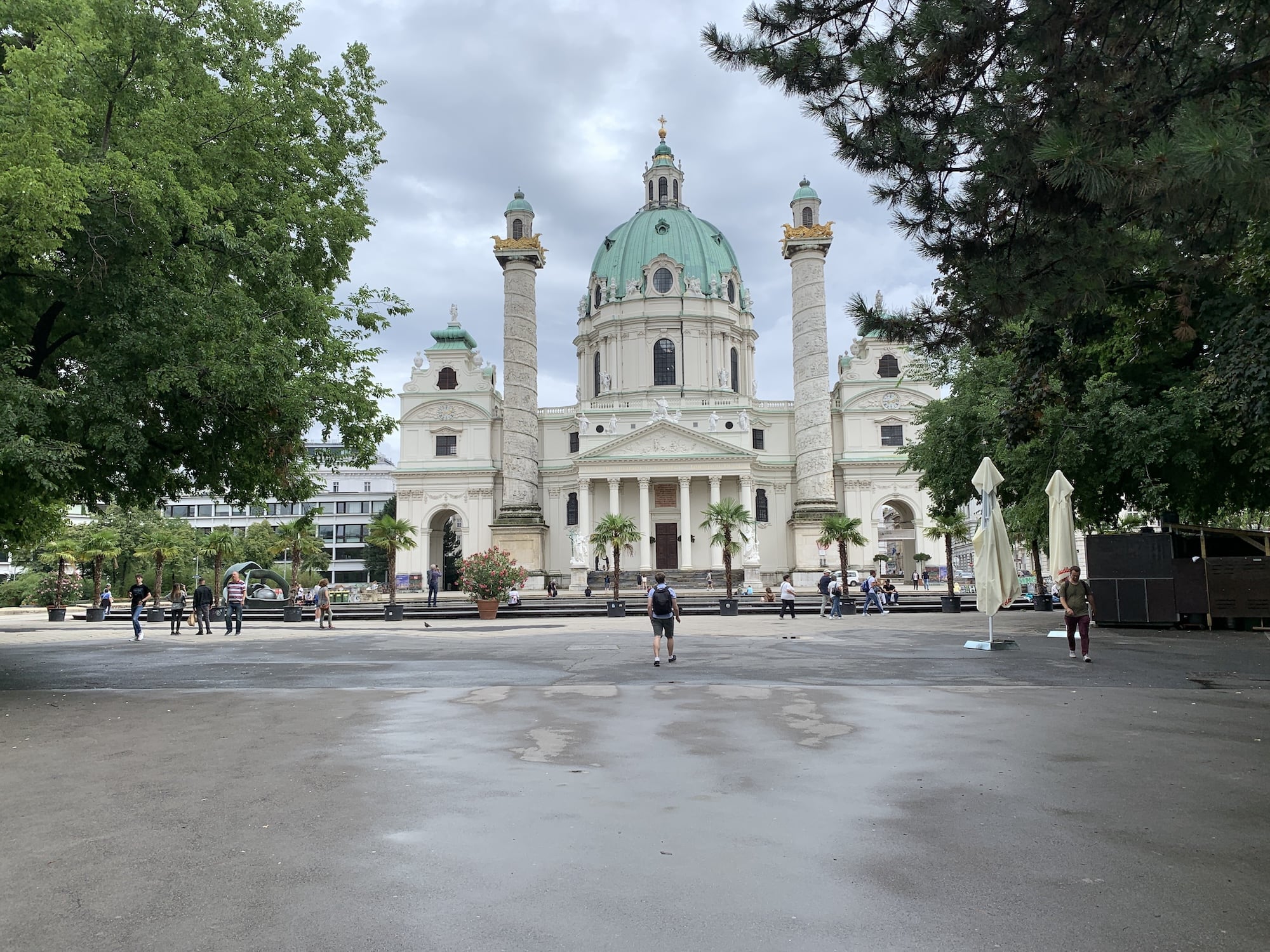
Vivaldi died in Vienna during the night of 27 to 28 July 1741. He was buried later that day in a simple grave at the Spitaler Gottesacker, a cemetery belonging to Vienna’s civic hospital fund. It stood only a few metres from the Karlskirche.
The cemetery was later closed and eventually disappeared as the area around Karlsplatz was redeveloped. Part of the site is now occupied by the Vienna University of Technology, usually known as TU Wien.
Vivaldi’s exact grave can no longer be identified and his remains were not preserved. Today, a modest plaque on the university building at Karlsplatz 13, facing the Karlskirche, commemorates the approximate location of his burial.
It is remarkably easy to walk past without noticing it.
Can you visit Vivaldi’s grave?
Not in the traditional sense. There is no gravestone, tomb or surviving cemetery. The plaque marks the historical location rather than an identifiable grave.
Still, the spot is worth visiting if you are interested in Vienna’s musical history. Standing between the Karlskirche and the university, it is strange to realise that one of the world’s best-known Baroque composers was buried beneath what is now a busy part of central Vienna.
The Karlskirche regularly hosts performances of The Four Seasons, giving the concerts an added historical connection: Vivaldi’s lost resting place lies only a short distance away.
Mozart: a memorial, but no certain grave
Wolfgang Amadeus Mozart presents a similar problem.
Mozart died in Vienna on 5 December 1791 and was buried at St. Marx Cemetery. Contrary to a persistent myth, he was not thrown into a mass grave. He received a standard communal burial in accordance with the customs and regulations of the period.
However, the exact location of his grave was not permanently marked. By the time people attempted to identify it years later, its precise position had been forgotten.
A memorial now stands at St. Marx Cemetery on the presumed site of his burial. It is atmospheric and well worth visiting, but it should not be mistaken for an authenticated grave.
There is also a Mozart monument among the renowned composers at Vienna Central Cemetery. This is a cenotaph, or memorial without remains. Mozart himself is not buried at the Zentralfriedhof.
That distinction regularly confuses visitors who expect to find him beside Beethoven and Schubert.
Beethoven and Schubert: moved to the Zentralfriedhof
Ludwig van Beethoven and Franz Schubert were originally buried at the former cemetery in Währing.
Beethoven died in Vienna in 1827. Schubert, who greatly admired him, died the following year and was buried nearby. When the old cemetery was closed, both composers were reinterred at Vienna Central Cemetery in 1888.
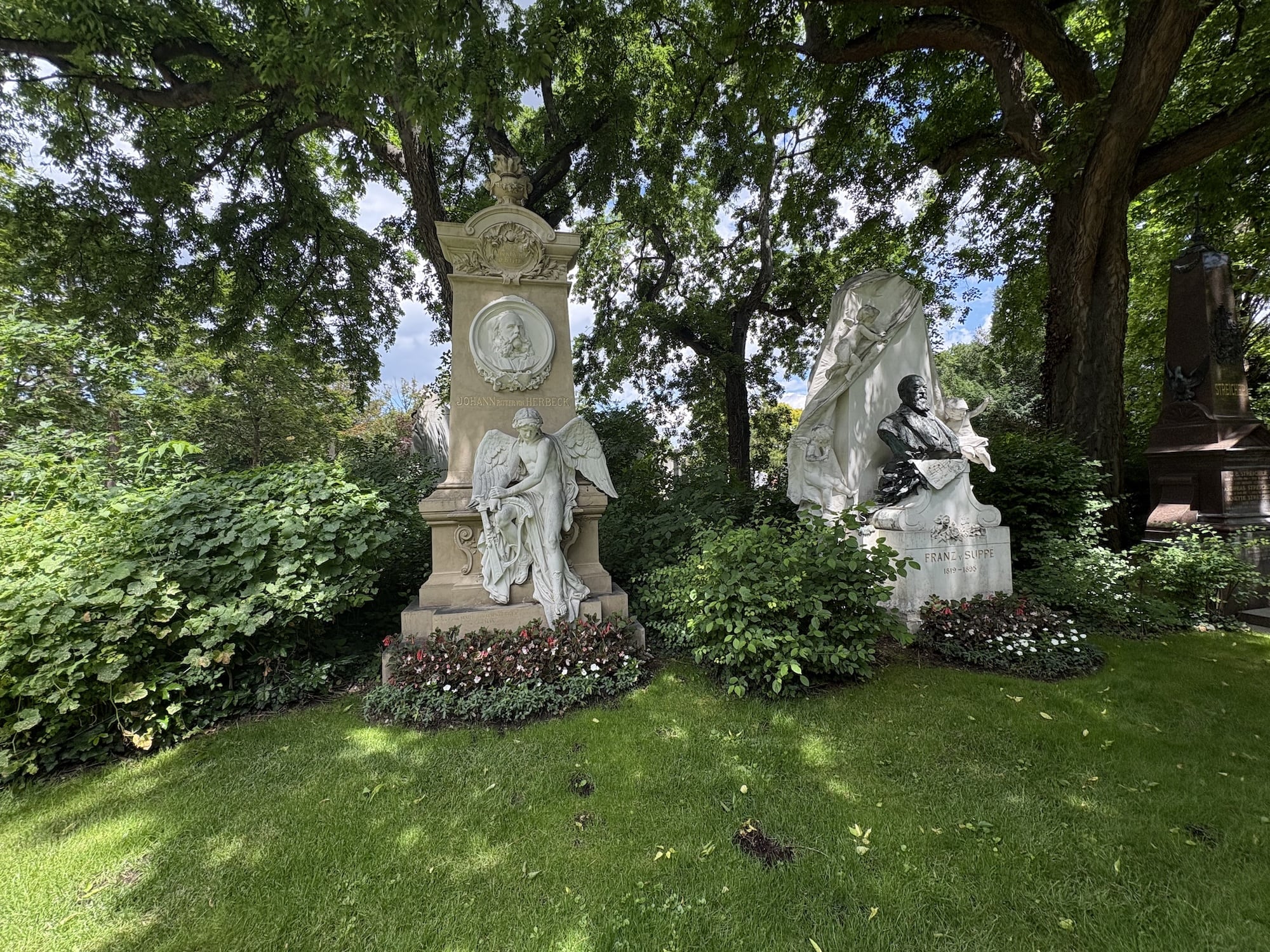
Their honorary graves now stand close together in the famous composers’ section near Karl Borromäus Church.
This is one of the most visited areas of the Zentralfriedhof. Even visitors with little interest in cemeteries often come to see the graves of Beethoven, Schubert, Johannes Brahms and Johann Strauss II.
A memorial to Mozart stands between them, symbolically bringing together several of Vienna’s greatest musical figures—even though Mozart’s remains are elsewhere.
Johann Strauss II: the Waltz King at the Zentralfriedhof
Few musicians are as closely connected with Vienna as Johann Strauss II.
Known as the Waltz King, Strauss composed The Blue Danube, The Emperor Waltz and the operetta Die Fledermaus. His music continues to shape the international image of Vienna and remains central to the annual Vienna New Year’s Concert.
Strauss died in 1899 and was buried in an honorary grave at Vienna Central Cemetery. His monument is found in the composers’ section near Beethoven, Schubert and Brahms.
It is one of the easiest famous graves to include in a visit because the principal composers’ memorials are grouped relatively close together.
Falco: Vienna’s pop star among ordinary Viennese
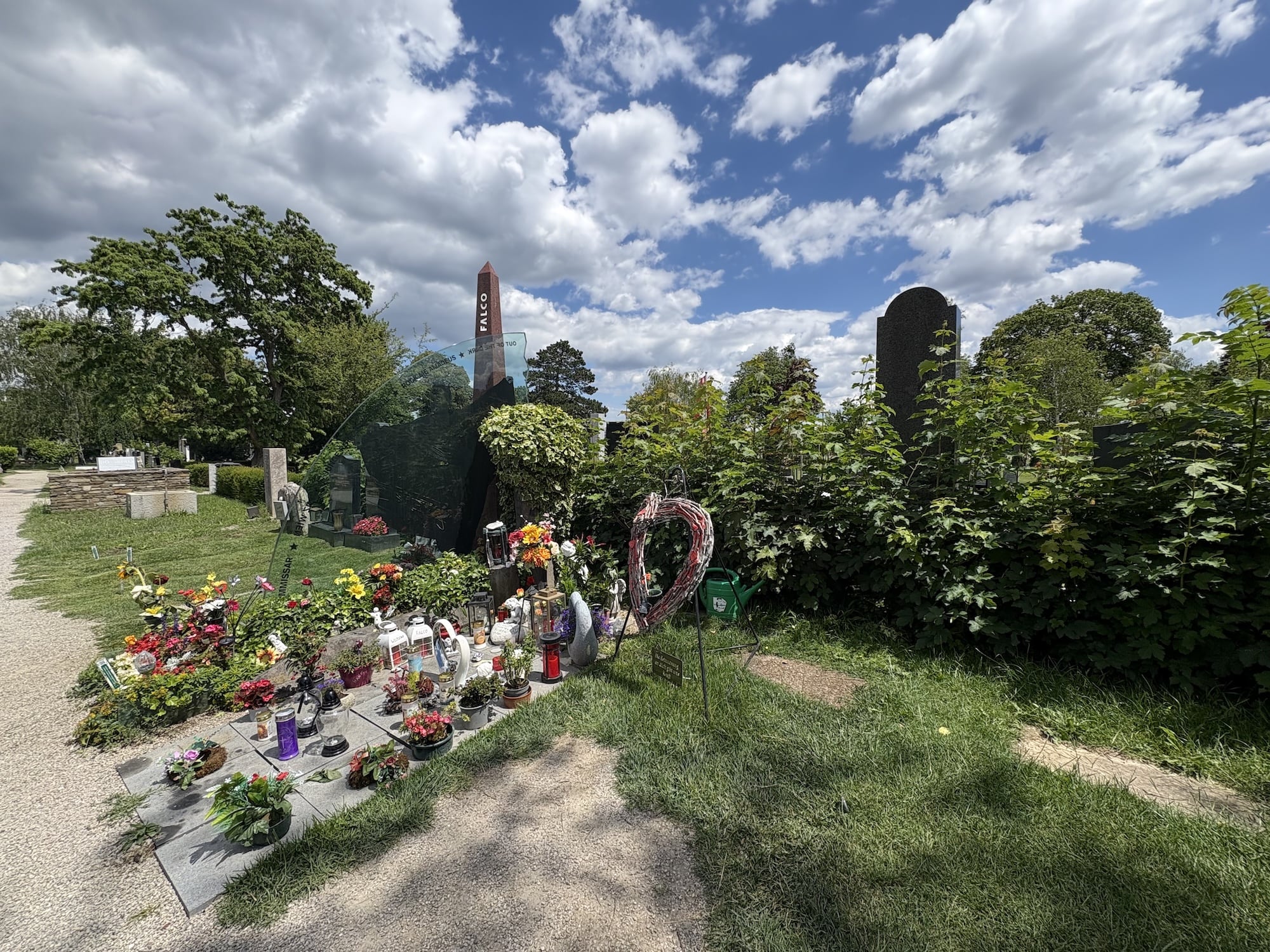
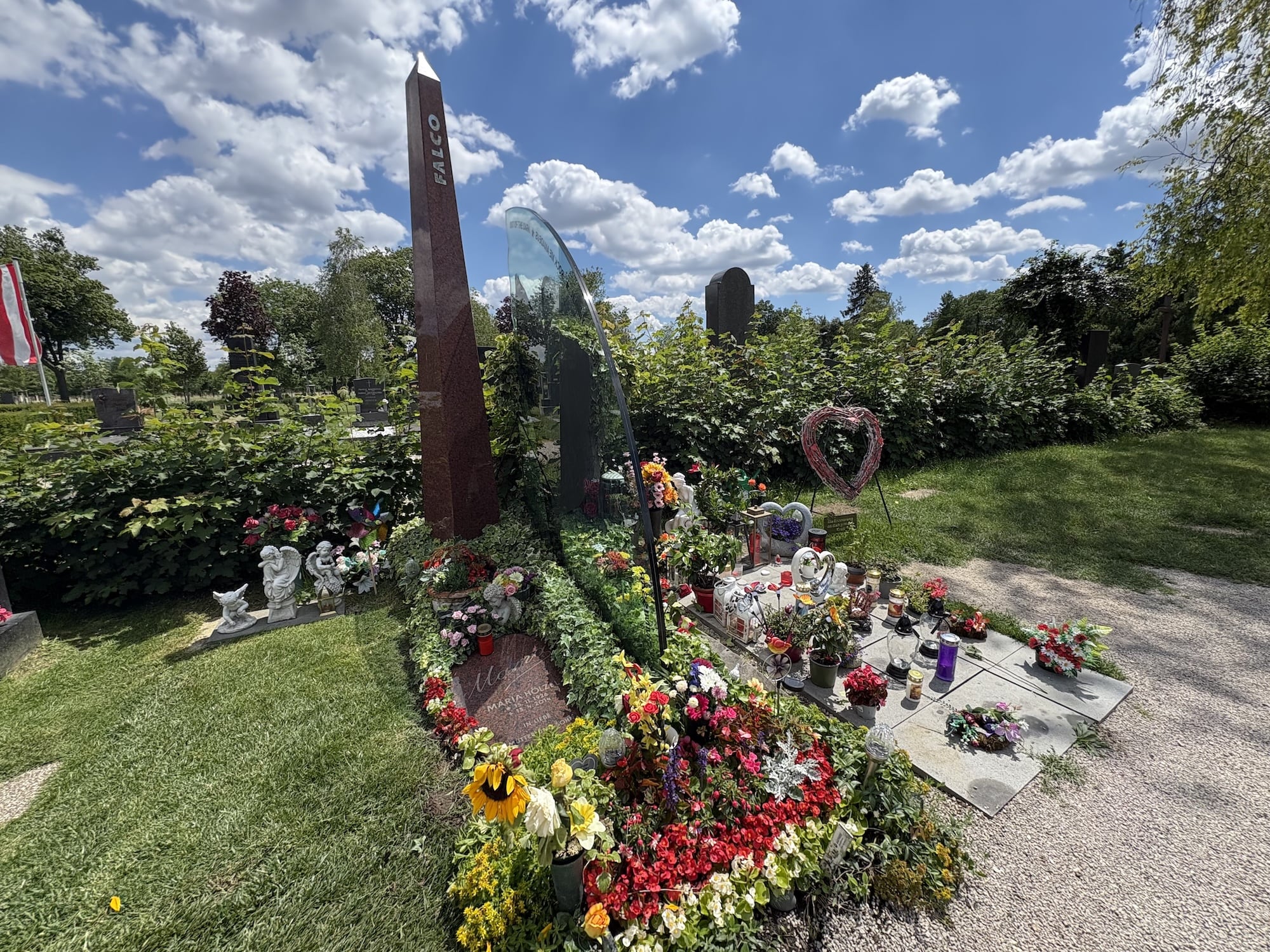
Falco belongs to a completely different musical era, but his grave has become one of the most visited at Vienna Central Cemetery.
The Austrian singer behind Rock Me Amadeus, Jeanny and Vienna Calling died in a traffic accident in the Dominican Republic on 6 February 1998. He was returned to Vienna and buried at the Zentralfriedhof under enormous public attention.
Many visitors assume Falco lies beside the famous composers and other honorary graves near Karl Borromäus Church. He does not.
His grave is located in Group 40, Grave 64, close to Gate 3. Although it has official honorary status, it stands within a regular burial section among the graves of other Viennese residents.
In some ways, the location feels appropriate. Austria’s most internationally successful pop star rests not in a formal musical pantheon, but among the people of his home city.
The grave is recognisable by its tall monument, glass portrait and the flowers, candles and messages continually left by fans.
Udo Jürgens: an unusual grand piano memorial
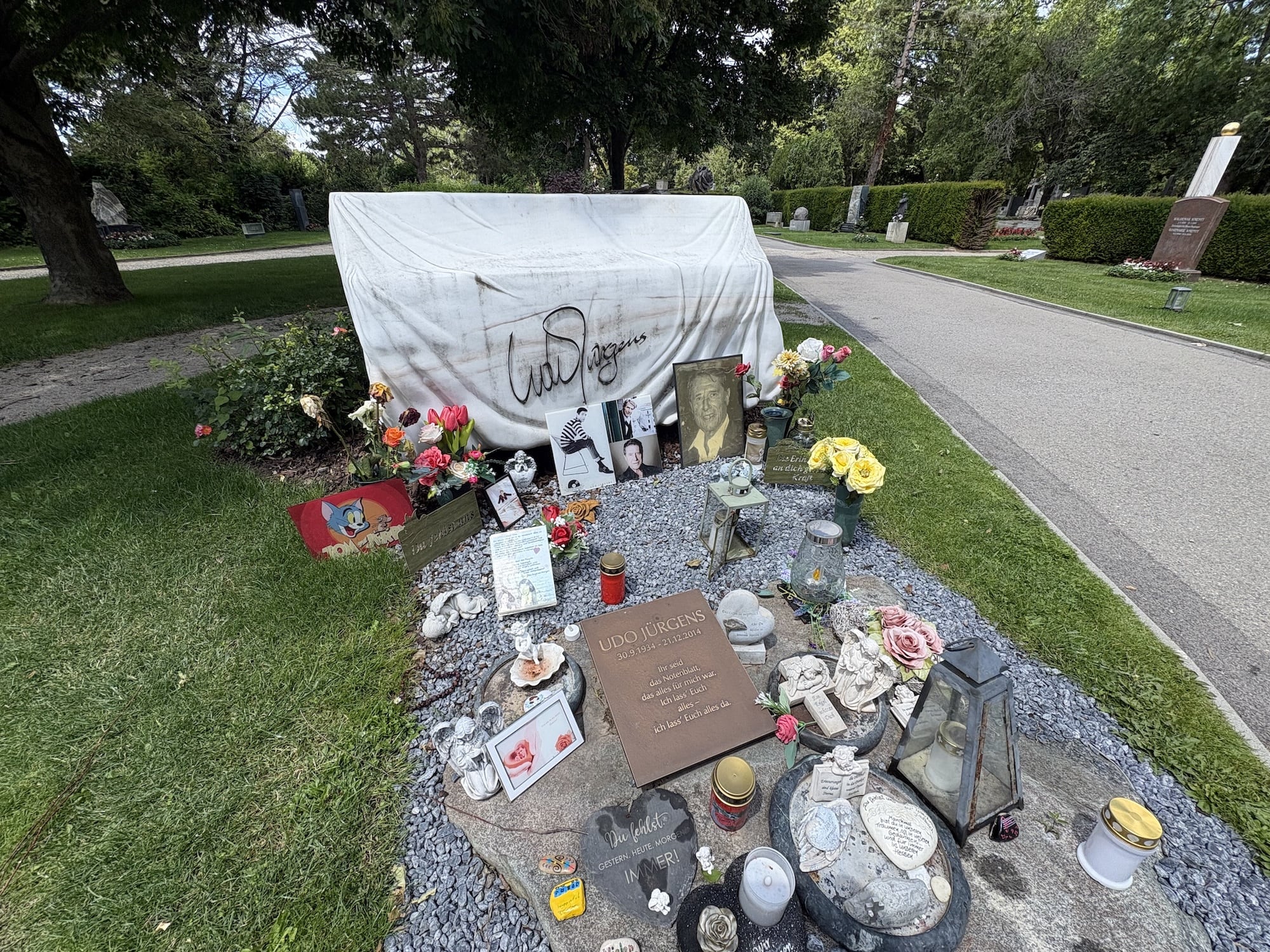
Another major name in Austrian popular music is Udo Jürgens.
The singer, pianist, and composer became one of the most successful German-language performers of the 20th century. His best-known songs include Griechischer Wein, Merci, Chérie and Ich war noch niemals in New York.
Jürgens died in 2014 and received an honorary grave at Vienna Central Cemetery. His memorial is easy to recognise: it resembles a white grand piano draped in cloth.
The design makes it one of the Zentralfriedhof’s most distinctive modern graves and a popular stop for visitors from Austria, Germany, and Switzerland.
Read more about the Zentralfriedhof in Vienna
More than a collection of celebrity graves
Visiting these locations reveals more than where famous musicians were buried. Together, they tell part of Vienna’s complicated history.
Old cemeteries disappeared as the city expanded. Graves were moved, forgotten or built over. Some artists received magnificent monuments decades after their deaths, while others vanished into ordinary burial grounds.
Vivaldi’s forgotten grave beside Karlsplatz, Mozart’s uncertain resting place at St. Marx and Falco’s constantly visited memorial at the Zentralfriedhof each show a different way in which Vienna remembers its musicians.
The city may celebrate music everywhere, but its composers did not all receive the grand farewell we associate with them today.
Planning a musical-graves route through Vienna
You do not need to visit all these places in one day. They are spread across different parts of Vienna.
A logical route could include:
- Karlsplatz for Vivaldi’s memorial plaque and the Karlskirche.
- St. Marx Cemetery for Mozart’s presumed burial place.
- Vienna Central Cemetery for Beethoven, Schubert, Brahms, Johann Strauss, Udo Jürgens and Falco.
Allow at least half a day for the Zentralfriedhof alone. The cemetery is enormous, and Falco’s grave is around 25 minutes on foot from the main composers’ section.
Our complete guide to Vienna Central Cemetery explains which entrance to choose, how to get there, what to see and how much time you will need.
Final thoughts
Vienna’s musical history is not confined to concert halls and opera houses. It can also be found on university walls, in forgotten cemeteries and along the tree-lined avenues of the Zentralfriedhof.
Vivaldi rests somewhere beneath modern Karlsplatz, Mozart’s exact grave has been lost and Beethoven was moved decades after his death. Falco, meanwhile, continues to receive flowers and messages from fans from around the world.
These places are often quiet and understated, but they offer a fascinating perspective on the musicians who helped make Vienna the City of Music.